
When a tenant improvement project goes sideways, the property manager takes the heat. The tenant complains about delays. The owner questions the budget. The contractor points fingers at the subcontractors, and the subcontractors point back. You're left managing a chain of excuses instead of a finished space.
A trustworthy commercial contractor in Phoenix carries an active ROC license, comprehensive general liability and workers' comp insurance, verifiable references from similar projects, and a written warranty on workmanship. Look for in-house capability across design, permitting, and construction (not a coordinator who farms everything out) and insist on a fixed-price proposal with a realistic timeline you can hold them to.
This guide walks through the vetting framework property managers, architects, and HOA boards use to separate capable commercial contractors in Phoenix from coordinators who overpromise and underdeliver. You'll learn the baseline credentials every contractor must meet, the structural advantages of full-service delivery, and the red flags that predict mid-project failures. By the end, you'll have a checklist you can use in your next contractor meeting, whether you're scoping a multi-unit tenant improvement, an office build-out, or a ground-up commercial construction project in Phoenix's East Valley.
Not every contractor who claims commercial construction Phoenix experience can handle a multi-trade, multi-month project where timeline slips and budget overruns reflect on you. The difference between a residential handyman who dabbles in commercial work and a true commercial general contractor comes down to three structural capabilities: in-house execution across trades, verifiable credentials that meet Arizona standards, and a documented track record on projects of similar scope and complexity.
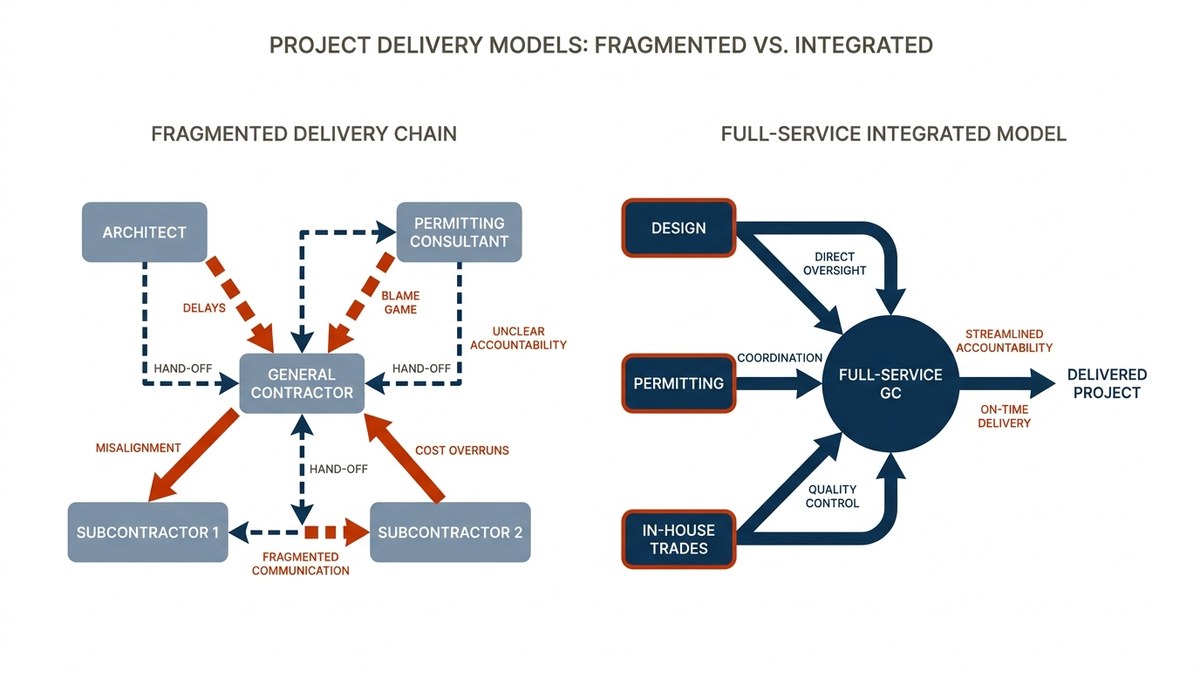
A general contractor who subcontracts all work functions as a project coordinator, not a builder. When design, permitting, framing, electrical, plumbing, and finish work are handled by separate vendors, timeline delays cascade. The electrician waits for the framer. The inspector flags a permitting issue the designer didn't catch. The finish carpenter can't start because the plumber ran late. Each hand-off introduces a delay, and when something goes wrong, everyone points at someone else.
A contractor for businesses with in-house capability owns the core trades under one roof. Design errors get caught before permitting. Permit delays don't snowball because the same team that drew the plans pulls the permits and coordinates the inspections. Framing, electrical rough-in, and MEP coordination happen on a single timeline managed by one superintendent, not negotiated across three separate companies. The accountability is direct. If the project runs late, there's one phone number to call and one team responsible for fixing it.
When one team owns the whole process from design through delivery, you get the accountability model that public procurement already requires. For property management and HOA construction, that single-team structure eliminates the coordination gaps that plague multi-vendor projects.
Every commercial contractor in Arizona must carry an active Registrar of Contractors (ROC) license. The ROC issues licenses by classification. A contractor licensed for residential work (KB-01) cannot legally bid commercial projects (A, B-2, or specialty commercial classifications). Verify the license number online through the Arizona ROC license lookup tool, which shows the contractor's classification, bond status, workers' compensation coverage, and complaint history.
Insurance minimums for commercial work exceed residential thresholds. Confirm that general liability coverage meets or exceeds industry standards, and verify that workers' compensation covers every employee on-site. Bonding requirements apply to public and municipal projects, but private property managers and developers increasingly require performance and payment bonds for projects above $500,000 to protect against contractor default or mechanic's liens from unpaid subcontractors.
Ask for certificates of insurance directly from the contractor's carrier, not a photocopy the contractor provides. The certificate should name you (the property owner or manager) as an additional insured and include 30-day cancellation notice. A contractor who resists providing current COIs or offers expired certificates is either uninsured or underinsured, and that risk transfers to you if someone gets hurt on-site.
A contractor who claims "20 years of experience" may have 20 years of residential remodeling and six months of commercial work. Ask for three references from projects of similar scope, timeline, and budget. A tenant improvement reference for a 5,000-square-foot office build-out is relevant if you're scoping a 6,000-square-foot retail space. A ground-up single-family home is not.
Call the references and ask specific questions: Did the contractor finish on time? Did they stay within budget, or were there change orders? How did they handle unexpected issues (permitting delays, material shortages, design changes)? Would you hire them again? A contractor with a strong track record will give you direct contact information for past clients, not vague "we've worked with major property managers" claims without names.
Verify ROC complaint history through the Arizona ROC complaint lookup. A clean complaint record doesn't guarantee future performance, but a pattern of unresolved complaints (failure to complete work, abandonment, unpaid subcontractors) predicts future problems. Check Google reviews and Better Business Bureau ratings for pattern data. One negative review may be an outlier. Ten reviews describing the same issue (poor communication, missed timelines, surprise costs) is a pattern.
Property managers responsible for multi-property portfolios or high-value tenant improvement projects face a core decision: hire separate vendors for design, permitting, and construction, or work with a contractor who owns the entire process in-house. The fragmented model may look cheaper on paper (three competitive bids instead of one), but it introduces coordination risk, timeline slippage, and accountability gaps that cost more in the long run. For property managers and architects targeting qualified commercial leads and building trust before requesting estimates, the full-service model addresses the number-one pain point directly: "I need one accountable team, not a chain of subcontractors."
When design, permitting, and construction are separate contracts, problems compound. The architect designs a layout that doesn't meet Phoenix fire code for the occupancy type. The contractor discovers the issue during permit review and requests a redesign. The architect bills for the revision as a change order. The permit timeline slips by three weeks. The tenant's move-in date shifts, and the property manager negotiates lease concessions to compensate. By the time the project finishes, the budget and timeline have both stretched, and no single vendor is accountable for the cascade.
A full-service contractor absorbs that coordination risk. When the same team that drew the plans pulls the permits and builds the project, design errors get caught in internal review before the plans go to the city. Code compliance issues surface during the design phase, not mid-construction. The permitting timeline is built into the project schedule from day one, and the contractor owns the milestone, not the architect. If something goes wrong, you call one number and talk to the team accountable for the entire delivery.
The single-contract model eliminates the blame-shifting dynamic. The architect can't blame the contractor for not following the design. The contractor can't blame the architect for unbuildable details. You have one throat to choke, and that clarity accelerates problem-solving.
The typical commercial tenant improvement project in Phoenix runs 12 to 16 weeks from permit submittal to certificate of occupancy. That timeline assumes no major design changes, no permitting delays, and smooth coordination between the design team, the permitting authority, and the construction crew. In a fragmented model, those assumptions rarely hold.
Hand-off delays account for a significant portion of total project duration. The architect finalizes the design and hands off construction documents to the contractor. The contractor reviews the plans, requests clarifications, and waits for the architect to respond. The city issues permit comments, and the contractor sends them back to the architect for revisions. The architect resubmits, the city re-reviews, and the permit is approved weeks later than planned. By the time construction starts, the tenant's lease commencement date is at risk, and the property manager is negotiating rent abatement.
A full-service contractor eliminates those hand-offs. The designer sits in the same office as the permit coordinator and the project superintendent. Design questions get answered in real time. Permit comments trigger same-day plan revisions. Construction starts as soon as the permit is issued because the build team has been involved in the design from day one. The timeline compresses compared to the fragmented model, and that speed protects the tenant's move-in date and the property's cash flow.
For commercial tenant improvement and build-out projects, integrated delivery cuts weeks off the schedule and keeps projects moving toward occupancy without the coordination delays that plague multi-vendor approaches.
In the fragmented model, the architect's professional liability insurance covers design errors, but it doesn't cover the contractor's workmanship. The contractor's warranty covers installation defects, but it doesn't cover design flaws that pass permitting but fail in practice (undersized HVAC, insufficient electrical capacity, ADA non-compliance that wasn't flagged). If a problem surfaces six months after occupancy, you're left coordinating claims between two separate vendors, each arguing the defect is the other's responsibility.
A full-service contractor warrants the entire stack: design errors, permitting oversights, and workmanship defects. If the HVAC system the contractor designed and installed fails to maintain temperature in a Phoenix summer, you call one number and the contractor owns the fix. If the electrical panel the contractor specified and wired trips under normal load, the contractor upgrades it at no cost. There's no coordination, no finger-pointing, and no gap between the design warranty and the construction warranty.
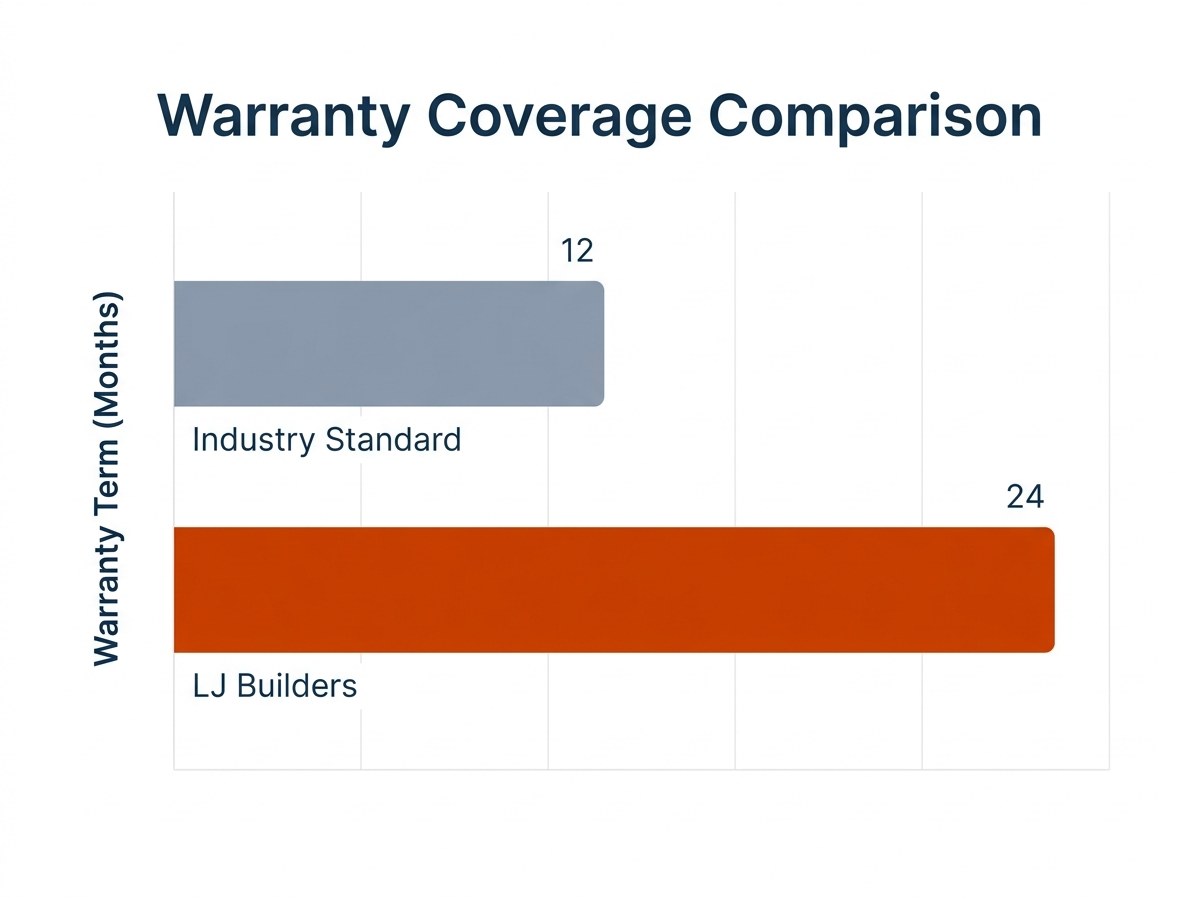
The warranty term matters as much as the scope. Industry-standard commercial construction warranties typically run one year on workmanship. A two-year warranty signals confidence in both the design and the execution, and it gives you an extra 12 months of protection against latent defects that don't surface immediately. That extended coverage becomes a key differentiator when property managers evaluate contractors, directly supporting the trust and transparency that converts estimates into signed contracts.
For commercial property managers and HOA boards evaluating contractors, the full-service advantage translates to faster timelines, clearer accountability, and comprehensive warranty coverage that fragmented models can't match.
A contractor who looks capable on paper may fail mid-project if you don't know what warning signs to screen for. Property managers and architects who've been burned once develop pattern recognition. Here are the red flags that predict timeline delays, budget overruns, and abandoned projects.
If the contractor won't put the warranty in writing, or uses language like "we stand behind our work" without defining the term or scope, walk away. A real warranty specifies the coverage period (one year, two years), the scope (workmanship only, or workmanship plus design and materials), the exclusions (normal wear, client-caused damage), and the claims process (who to call, response timeline, resolution procedure).
Ask to see a sample warranty certificate before you sign the contract. The certificate should be on the contractor's letterhead, name the project and the owner, state the warranty term and start date (typically the certificate of occupancy date), and include the contractor's contact information and ROC license number. A verbal promise to "make it right" is unenforceable. A written warranty with a defined term and scope is a contract you can hold the contractor to.
Warranty coverage should extend beyond workmanship to include design errors and permitting oversights when the contractor handles design and permitting in-house. If the contractor designed a structural element that fails code inspection six months after occupancy, the warranty should cover the redesign and the correction. If the contractor pulled a permit for one scope and the city later flags a non-compliance issue, the warranty should cover the remediation. A warranty that covers only the contractor's hands-on installation work leaves you exposed to design and permitting risk.
For property managers comparing contractors, warranty terms directly affect the trust decision and long-term project success. Extended warranty periods signal confidence in execution and materials sourcing, addressing one of the core trust factors that converts estimates into signed contracts.
A contractor who promises a six-week tenant improvement without seeing the space, reviewing the permitting timeline, or understanding the scope is either lying or incompetent. Honest contractors deliver realistic timelines based on the actual work, the permitting authority's current review backlog, and the inspection schedule. A lowball timeline that sounds too good to be true usually is.
Ask the contractor to walk through the project schedule in detail: How long for design and plan review? How long for permit submittal and approval? How long for rough-in, inspections, and finish work? What's the contingency for permitting delays or material lead times? A contractor who can answer those questions with specific durations and milestone dependencies has planned the project. A contractor who says "we'll get it done in six weeks" without showing the work behind the estimate is guessing.
Compare the contractor's timeline to industry benchmarks. The average office tenant improvement in Phoenix runs 12 to 16 weeks from permit submittal to certificate of occupancy. A contractor promising eight weeks for a similar project is either cutting corners (fewer inspections, lower-quality materials, unlicensed subcontractors) or setting you up for a timeline overrun and lease concession negotiations with the tenant.
Honest timelines protect you even when they're longer than the competition. A contractor who promises 14 weeks and delivers in 13 has exceeded expectations. A contractor who promises 8 weeks and delivers in 16 has broken trust and potentially cost you tenant revenue. For property managers responsible for budget and timeline predictability, the honest contractor wins every time.
A general contractor who subcontracts all work is a project coordinator, not a builder. When a problem surfaces, the GC calls the subcontractor, waits for the subcontractor to respond, relays the information back to you, and waits for the subcontractor to fix it. You've added a layer of latency and cost without gaining any in-house capability.
Ask the contractor which trades they perform in-house: framing, electrical, plumbing, HVAC, drywall, finish carpentry, cabinetry. A contractor with in-house framing and finish carpentry can start work faster and respond to changes in real time. A contractor who subcontracts everything adds coordination overhead to every decision. When the tenant requests a layout change mid-project, the in-house contractor adjusts the framing crew's schedule that afternoon. The subcontractor-only GC sends an RFI to the framing sub, waits for a response, negotiates a change-order price, and reschedules the work two weeks out.
The subcontractor model introduces accountability gaps. When the drywall doesn't match the approved finish schedule, the GC blames the drywall sub. The drywall sub blames the GC for unclear specifications. You're left mediating a dispute between two vendors instead of holding one contractor accountable. A contractor with in-house trades owns the outcome. If the drywall is wrong, they fix it, no excuses.
The full-service single-team model eliminates coordination risk, accountability gaps, and timeline delays inherent in multi-subcontractor models. When you're vetting contractors for a complex commercial project, in-house capability is a structural advantage, not a nice-to-have.
Now that you've internalized the vetting framework, here's how LJ Builders meets every criterion and exceeds on warranty and owner-led accountability. Every claim below is backed by a credential, a named reference, or a specific capability you can verify before you request an estimate.
LJ Builders owns the whole process. Design, permitting, construction, cabinetry, and insurance coordination all happen in-house under one contract. No hand-offs, no coordination gaps, no finger-pointing. You get one timeline, one fixed price, and one point of contact (Lawrence or Jessica) who oversees your project from concept through certificate of occupancy.
The in-house scope covers tenant improvements, office and retail build-outs, commercial additions, casitas, and ground-up builds across Phoenix's East Valley. ROC license #332589 authorizes commercial general contracting, and the license is active and verifiable through the Arizona ROC lookup tool. Design and permitting coordination means you don't hire an architect separately and then negotiate between the architect and the builder when the design and the budget don't align. The same team that draws the plans prices the work, pulls the permits, and builds the project.
Custom cabinetry and millwork happen in-house, which eliminates the two-to-four-week lead time and coordination overhead of ordering cabinets from a third-party supplier. When the tenant requests a custom reception desk or a built-in shelving system, LJ designs it, builds it, and installs it on the project timeline without waiting for a cabinet shop's production schedule.
For property managers and architects scoping commercial construction projects, the full-service model means faster timelines, tighter budget control, and single-point accountability. This integrated approach supports property management and HOA construction solutions across multi-property portfolios, enabling long-term project relationships where one successful delivery unlocks repeat business worth hundreds of thousands annually.
LJ Builders backs every commercial project with a two-year written warranty on workmanship, double the industry standard. Most commercial contractors offer one year of warranty coverage, and some offer none in writing at all. The two-year term gives you an extra 12 months of protection against latent defects and workmanship issues that don't surface immediately after occupancy.
The warranty scope covers workmanship on all in-house trades (framing, finish carpentry, cabinetry, coordination work) and includes corrections of others' bad work when LJ takes over a project mid-stream. If you hire LJ to fix a botched tenant improvement another contractor abandoned, the warranty covers both the new work and the corrections. That's accountability you can hold in writing.
The warranty certificate specifies the term, the start date (certificate of occupancy), the scope, and the claims process. If a defect surfaces, you call Lawrence or Jessica directly, and they schedule a site visit to assess and resolve the issue. No third-party warranty administrator, no claims paperwork, no waiting for a response. The owners personally oversee the resolution.
For property managers and HOA boards who've been burned by contractors with vague or non-existent warranty coverage, the two-year written warranty is the trust differentiator that supports long-term client relationships and justifies choosing LJ Builders over lower-cost competitors.
LJ Builders' track record isn't anecdotal. The firm has long-term relationships with multi-property operators including GreyStar, FSR, and CCMC, all verifiable through direct contact. These are property management companies responsible for hundreds of units across Phoenix's East Valley, and they return to LJ for repeat projects because the firm delivers on time, stays within budget, and handles tenant-occupied work with minimal disruption.
Ask for references from past projects similar to yours in scope, timeline, and budget. LJ will provide direct contact information for property managers and building owners who've worked with the firm on tenant improvements, build-outs, and commercial renovations. Call them and ask the questions that matter: Did LJ finish on time? Did they stay within the estimate, or were there surprise costs? How did they handle unexpected issues? Would you hire them again?
The referral partner list proves LJ can handle the complexity, coordination, and accountability demands of commercial work at scale. For property managers evaluating contractors, named references from repeat clients are the strongest signal of capability and reliability.
LJ Builders isn't a faceless operation. Lawrence and Jessica (the "L" and "J") personally oversee every project. You don't get handed off to a project manager who's juggling 15 other jobs. You get direct access to the owners, and they treat your project as if it were their own because their reputation is on the line with every estimate, every timeline, and every warranty claim.
The owner-led model means faster decision-making and accountability you can count on. When a design question surfaces mid-project, you call Lawrence or Jessica and get an answer that afternoon, not three days later after the question filters through a project coordinator and a regional manager. When a timeline issue arises, the owners adjust the schedule and the crew deployment personally, not through a layer of middlemen.
Backed by Tony, Jose, and a crew with over 20 years of combined experience, LJ Builders combines local, relationship-driven service with the in-house capability and technical expertise to handle complex multi-trade projects. The team is small enough to stay personally invested and large enough to own the full scope of design, permitting, construction, and custom cabinetry in-house.
For architects, property managers, and business owners who value direct communication and personal accountability, the owner-led model is the alternative to national franchises and corporate contractors where you're one project in a pipeline of hundreds. You can also explore residential construction and remodeling services in Phoenix to see how LJ's full-service approach extends beyond commercial work to high-end residential projects and insurance restoration.
Use this checklist in your next contractor meeting to screen for capability, accountability, and transparency. These questions work for any contractor, not just LJ Builders. They're designed to surface the gaps and red flags before you commit.
What's your ROC license number, and can I verify it online? Every licensed contractor in Arizona must provide their Registrar of Contractors license number. Verify it through the Arizona ROC license lookup to confirm the classification (commercial vs. residential), bond status, workers' comp coverage, and complaint history. A contractor who hesitates to provide the license number or offers an expired license is a red flag.
Do you carry general liability and workers' comp insurance? What are the coverage limits? Ask for certificates of insurance directly from the contractor's carrier. The certificate should name you as an additional insured and include 30-day cancellation notice. A contractor who can't provide current COIs is either uninsured or underinsured, and that risk transfers to you.
Can you provide three references from projects similar in scope, timeline, and budget to mine? A contractor with a strong track record will give you direct contact information for past clients. Call them and ask: Did the contractor finish on time? Stay within budget? Handle unexpected issues well? Would you hire them again? A contractor who offers vague "we've worked with major property managers" claims without names is hiding something.
What's your warranty term, and is it in writing? Industry-standard commercial warranties run one year on workmanship. A contractor offering two years or more is signaling confidence. Ask to see a sample warranty certificate. It should specify the term, the scope (workmanship, design, materials), the exclusions, and the claims process. A verbal promise to "make it right" is unenforceable.
Do you handle design and permitting in-house, or do I need to hire an architect separately? Full-service contractors eliminate the coordination risk and timeline delays of hiring separate vendors for design, permitting, and construction. A contractor who requires you to hire an architect separately is a builder, not a full-service GC. You'll inherit the hand-off risk and accountability gaps.
What's a realistic timeline for this project, and what's your track record for finishing on time? Ask the contractor to walk through the project schedule in detail: design and plan review, permit submittal and approval, construction phases, inspections. Compare the timeline to industry benchmarks (12 to 16 weeks for an average office TI in Phoenix). A contractor who promises an unrealistic timeline without showing the work behind the estimate is guessing, and you'll pay for that guess in delays and lease concessions.
If something goes wrong mid-project, who do I call? Single-point accountability means one contact who owns the entire delivery. A contractor who says "you'll work with our project manager, but if there's an issue, escalate to the regional manager" has introduced coordination layers. A contractor who says "you call me (the owner) directly" has eliminated the layers.
A botched commercial project costs you time, money, and reputation. The tenant leaves. The owner questions your judgment. The next project gets harder to fill because word spreads that your buildings come with construction risk. Choosing the right contractor isn't about finding the lowest bid. It's about finding the team with the credentials, the capability, and the accountability to deliver on time and on budget, every time.
The vetting framework is straightforward: verify the ROC license and insurance, ask for references from similar projects, insist on a written warranty with a defined term and scope, and choose a contractor with in-house capability across design, permitting, and construction. When you apply those criteria, you filter out the coordinators, the overpromisers, and the contractors who'll point fingers when something goes wrong.
LJ Builders meets the standard: ROC #332589, two-year written warranty, named referral partners (GreyStar, FSR, CCMC), full-service in-house capability, and owner-led accountability with Lawrence and Jessica personally overseeing every project. If you need a contractor who owns the whole process and delivers what they promise, get a free estimate and references from projects like yours. You'll get a detailed scope, fixed price, and realistic timeline before you make a decision.
By LJ Builders

Remodeling
LJ Builders handles every phase of custom kitchen design in-house: consultation, permitting, construction, and cabinetry installation. One owner-led team eliminates subcontractor hand-offs and timeline surprises, backed by a 2-year workmanship warranty that doubles the industry standard.

Remodeling
A kitchen renovation contractor in Gilbert should provide in-house design, permitting, construction, and cabinetry under one accountable team. LJ Builders delivers owner-led projects backed by a two-year workmanship warranty, transparent pricing, and 20-plus years of East Valley expertise.

Remodeling
A kitchen remodel contractor in Chandler should offer full-service design, permitting, construction, and custom cabinetry under one team. LJ Builders delivers 6 to 12-week timelines, fixed-price estimates, and a 2-year workmanship warranty. ROC licensed with 20+ years of East Valley experience.