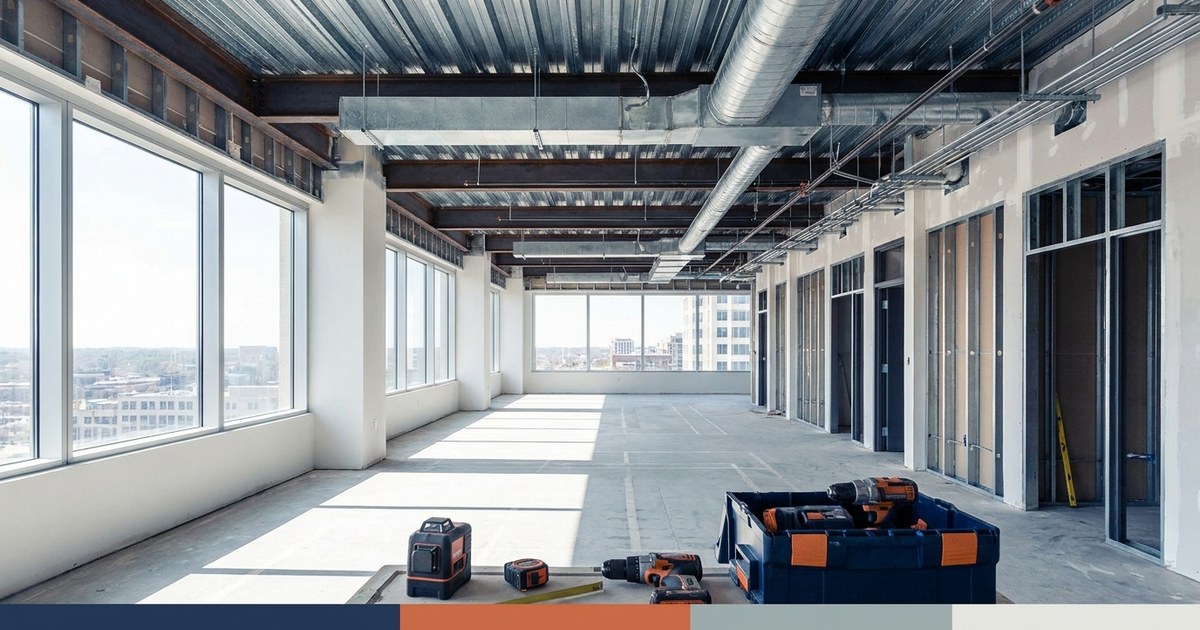
What does a 2-year workmanship warranty cover in commercial construction? A 2-year workmanship warranty guarantees that the contractor will repair defects in labor and installation at no additional cost for 24 months post-completion. This coverage protects against drywall cracks, finish failures, and structural settling, signaling contractor confidence and quality standards that outlast the industry's typical 1-year coverage.
For property managers coordinating tenant improvements and business owners planning commercial build-outs, a longer warranty addresses a critical gap. Most construction defects don't surface until months 12 to 24, when seasonal temperature cycles stress improperly installed joints or HVAC integration issues emerge during full heating and cooling cycles. A tenant moves into new office space; six months later, drywall cracks appear above HVAC ductwork. With a 1-year warranty that expired weeks ago, the property manager absorbs the full cost of diagnosis and repair. Extended warranties eliminate this gap by covering the window when latent defects typically surface.
Understanding why warranty length matters requires examining what these warranties actually cover, why the industry defaults to inadequate terms, and what extended coverage reveals about a contractor's quality control systems and financial stability.
By LJ Builders
A workmanship warranty covers defects in labor and installation. If the contractor's crew installs drywall incorrectly and cracks develop along seams, or if HVAC integration creates airflow issues from poor duct routing, the contractor returns to fix it at no additional cost. Workmanship warranties are distinct from manufacturer warranties. The HVAC unit itself may carry a separate parts warranty from the equipment manufacturer, but the installation work (ductwork routing, register placement, system integration) falls under the contractor with 2 year warranty workmanship guarantee.
Commercial construction projects typically include coverage for:
Exclusions are equally important. A workmanship warranty does not cover damage caused by the property owner, tenants, or third-party vendors. A forklift puncturing a wall during tenant move-in is not a warranty claim. Normal wear and tear from building use is excluded. So are material failures covered by manufacturers. If the HVAC unit's compressor fails due to a manufacturing defect, the equipment manufacturer handles that claim. If the contractor installed the unit incorrectly and it vibrates loose from its mounts, that's a workmanship issue the contractor must resolve.
The Arizona Registrar of Contractors requires licensed contractors to follow minimum warranty standards, but those standards vary by project type. The industry default for commercial work is one year from final inspection or certificate of occupancy. LJ Builders extends that to two years because our in-house team controls every step: design consultation, permitting, construction, finish work, and systems coordination. We don't rely on fragmented subcontractor chains where warranty accountability gets lost in finger-pointing between trades.
Property managers and architects vetting contractors for tenant improvement projects should demand written warranty terms before signing. Verbal promises don't hold up when a defect appears 15 months post-completion. Written warranty documentation should specify the coverage period, what's included, what's excluded, the claims submission process, and response timelines.
Most commercial contractors cap workmanship warranties at 12 months for three reasons: risk mitigation, subcontractor liability limits, and cash-flow constraints. When a contractor relies on multiple subcontractors (one for electrical, another for HVAC, another for drywall, another for painting), each sub carries their own liability insurance and warranty terms. Coordinating a warranty claim across multiple parties six months after project completion is a logistics nightmare. The general contractor doesn't want to chase down a drywall subcontractor who has moved on to other projects, so they limit exposure by capping the warranty at one year.
Cash flow pressures also drive short warranty periods. Contractors operating on thin margins can't afford to return for unpaid warranty work 18 months after final payment. They need working capital allocated to active projects, not potential warranty claims on completed jobs.
The gap this creates is significant. Many latent defects don't surface until months 12 to 24. According to construction industry research published by Construction Dive, drywall cracks from structural settling typically appear 14 to 18 months post-completion as seasonal temperature and humidity cycles stress improperly installed joints or inadequate framing. HVAC integration issues (uneven airflow, duct leaks, condensation problems) often take a full heating or cooling cycle to reveal themselves. Arizona's extreme summer heat can expose HVAC sizing errors or ductwork insulation failures that weren't apparent during spring installations.
Waterproofing failures in commercial restrooms or break rooms may not show until the second year of heavy use when tile grout failures allow moisture penetration behind finished surfaces. Flooring adhesive failures from improper substrate preparation often manifest 15 to 20 months post-installation as foot traffic patterns stress weak bonds. Ceiling system failures from improper load distribution may not become apparent until tenants install lighting, projectors, or equipment that stresses poorly installed grid systems.
Property managers inherit all of this risk after the warranty expires. A commercial office build-out might pass final inspection cleanly. The contractor hits the schedule, the architect signs off, the tenant moves in. But if the contractor rushed the drywall finish to hit a lease-up deadline, joint compound failures will appear over the next year. By the time cracks show, the 1-year warranty has expired and the property manager is stuck sourcing a second contractor to diagnose and repair the issue.
The diagnostics process alone creates problems. A new contractor visiting the site 16 months post-completion doesn't have installation documentation, progress photos, or knowledge of what's behind the finished surfaces. They must make educated guesses or perform destructive testing (cutting into walls to inspect framing or systems) to diagnose properly. The property manager pays for diagnostics, pays for repair, and absorbs schedule disruption, all because the original warranty period was inadequate.
The one-year warranty standard protects contractors from liability at the expense of building owners. It shifts long-term risk to the property owner at precisely the moment when the original contractor's accountability should matter most.
Extending a workmanship warranty from one year to two reduces total cost of ownership in three measurable ways: fewer repair vendors, faster resolution timelines, and better tenant satisfaction.
Reduced total cost of ownership: When a defect surfaces 16 months post-completion and the original contractor's warranty has expired, the property manager must hire a diagnostics consultant to identify the root cause (often $500 to $1,500 for a site visit and written assessment), then source a second contractor to bid the repair. That's two vendor engagements, two invoices, two rounds of project management overhead, and duplicate mobilization costs. The second contractor prices the work as a standalone repair project with full profit markup because they have no relationship history.
With a 2-year warranty protection construction approach, one call to the original contractor resolves the issue. There's no finger-pointing because the contractor owns the entire scope. There's no diagnostics invoice because the contractor has full installation documentation. There's no competitive bidding because warranty work is covered at zero cost. The property manager's total involvement is one phone call and one follow-up to confirm completion.
Timeline protection: Warranty claims under the original contractor are resolved faster than sourcing new bids. LJ Builders guarantees a 48-hour response window for warranty claims. A property manager dealing with a drywall crack above a tenant's conference room can get it scheduled and repaired within days, not weeks. New contractor bids take time: initial site visit (one week out), estimate preparation (three to five days), client review and approval (several days), contractor scheduling (one to two weeks), mobilization. The cumulative delay can stretch to four to six weeks.
For commercial properties with active tenants, every day of delay creates operational disruption. A retail tenant can't display merchandise against a damaged wall. An office tenant can't use a conference room with visible defects during client meetings. Extended warranty coverage means faster resolution, which directly protects tenant relationships and lease renewals.
Tenant satisfaction: A defect discovered after tenant move-in becomes the property manager's problem to solve, not the contractor's. If the defect disrupts business operations (an HVAC issue causing temperature swings in server rooms, a drywall crack above retail displays, a door that won't seal properly), the tenant blames the property manager for delivering substandard space. A 2-year warranty means the property manager can resolve issues quickly under warranty coverage without explaining to the tenant why the original contractor won't honor their work.
This matters particularly for multi-tenant commercial properties where lease renewals drive long-term asset value. A tenant experiencing repeated maintenance issues during their first lease term is less likely to renew. The property manager must either offer rent concessions to retain the tenant or absorb vacancy and re-leasing costs. Both outcomes reduce net operating income.
In our tenant improvement work for property managers across the East Valley, the most common warranty claims occur 14 to 18 months post-completion, well beyond the industry's 1-year window. We've repaired drywall settling in office build-outs, HVAC register adjustments in medical suites, finish touch-ups in retail spaces, and door hardware adjustments. All were completed under warranty at zero cost to clients. That's proof our work holds up and our processes catch issues early.
The business case is straightforward: a 2-year contractor guarantee reduces total project cost by eliminating future rework invoices, diagnostics fees, and vendor coordination overhead. For architects specifying contractors in RFPs for commercial projects, warranty length should be a weighted criterion alongside price and schedule.
Warranty length is a reliable signal of three critical contractor attributes: in-house capability, financial stability, and process rigor. Contractors who rely on fragmented subcontractor chains cannot offer extended warranties because liability is distributed across too many parties. When responsibility is spread across five different subcontractors, coordinating a warranty claim becomes a legal and logistical tangle. The general contractor points to the electrician. The electrician blames the HVAC installer. No one fixes the problem because no one owns the full scope. Warranty accountability vanishes in the gaps between trades.
Only full-service contractors with direct oversight can back a 2-year promise. At LJ Builders, one integrated team handles design consultation, permitting coordination, framing, mechanical and electrical rough-in, finish work, cabinetry fabrication and installation, and final punch-list. When a warranty claim comes in, there's no finger-pointing because we performed the work with our own crews. Lawrence and Jessica personally oversee every project from initial site walk to final certificate of occupancy. That's how we structure accountability and maintain quality control across every phase.
This in-house model costs more to operate than a lean general contractor model that outsources everything. We maintain full-time employees with benefits, ongoing training, quality control systems, and equipment. But it allows us to guarantee results other contractors can't. When we install drywall, we know it will be installed to our standards because our crews did it. When we coordinate HVAC integration, we control the entire mechanical scope and ensure proper ductwork routing, register placement, and system balancing.
Financial stability matters equally. A contractor offering a 2-year warranty must have the working capital to honor claims 18 months post-completion. That requires stable cash flow, manageable debt levels, disciplined project margins, and financial reserves for warranty work. Contractors operating hand-to-mouth or chasing volume to cover overhead cannot afford to return for unpaid warranty work.
LJ Builders has operated under the same ROC license (ROC #332589) since 2003, providing over two decades of financial track record and accountability. We're not a startup contractor learning quality control through trial and error. Our stability allows us to make long-term commitments we know we can honor.
Process rigor is the third signal embedded in warranty length. A contractor confident enough to offer a 2-year workmanship warranty commercial coverage has standardized installation protocols, documented quality control checkpoints, and systematic handoff procedures between phases. We don't rush finishes to hit arbitrary deadlines. Every commercial build-out, tenant improvement, and office expansion we complete gets photographed at every critical phase: rough framing, MEP (mechanical, electrical, plumbing) rough-in, insulation, drywall, primer, finish coats. If a warranty claim surfaces 16 months post-completion, we have a full visual record of what was installed and how it was constructed.
This documentation serves two purposes: it helps us diagnose warranty claims quickly (we can compare current conditions to installation photos), and it provides evidence of proper installation if disputes arise. Property managers benefit because resolution is faster. We benefit because we can demonstrate we followed code requirements and best practices.
Warranty length is the easiest due diligence metric for property managers and architects evaluating contractors. If a contractor won't put a 2-year workmanship warranty in writing, that signals either financial instability (they can't afford to honor it), quality control problems (their work doesn't hold up), or reliance on subcontractor chains (they can't coordinate multi-party warranty claims).
For architects preparing RFPs for commercial tenant improvements or build-outs, warranty terms should be a mandatory submission requirement. Contractors must provide written warranty documentation specifying coverage period, scope, exclusions, claims process, and response timelines.
LJ Builders provides written warranty terms at contract signing, not as a separate document clients must request. The warranty document specifies what's covered, what's excluded, the claims submission process, and guaranteed response timelines. There are no verbal-only promises and no vague exclusion clauses buried in fine print designed to invalidate legitimate claims.
Coverage begins at certificate of occupancy issuance. East Valley municipalities require commercial projects to pass final inspection before COs are issued through their building safety departments. Building inspectors verify code compliance for structural, mechanical, electrical, plumbing, and fire safety systems before authorizing occupancy. The 2-year warranty clock starts when the CO is signed, not at contractor handoff or when the contractor declares a project "substantially complete."
Response window: 48 hours. When a property manager or business owner submits a warranty claim (via phone, email, or our online portal), we acknowledge receipt within 48 hours and schedule a site visit within one week. Most claims are resolved in a single visit. Simple issues (finish touch-ups, minor adjustments, hardware repairs) are completed on-site immediately. If the issue requires parts or materials, we provide a written timeline and keep the client updated at every step.
Owner-led oversight. Lawrence and Jessica personally review every warranty claim. If the claim is legitimate (the defect resulted from our installation error or material choice), we schedule repair immediately and notify the client of the resolution timeline. If the claim falls outside warranty terms (owner-caused damage, normal wear and tear, third-party modifications), we explain why in writing and offer a paid repair estimate if requested.
Documented exclusions: The warranty does not cover:
These exclusions are standard in construction contracts and protect contractors from liability for conditions outside their control. The key difference is we state them clearly in writing rather than burying them in vague language that allows us to deny any claim.
Examples of past claims honored:
We track warranty claims by project type and phase to identify process improvements. If we see multiple warranty claims for the same issue, we modify our installation protocols to prevent future occurrences.

Written terms are non-negotiable when evaluating contractor warranties. If a contractor won't provide warranty language in the contract or proposal, that's an immediate red flag signaling potential future problems. Verbal promises evaporate when the project is complete and the contractor has moved on to the next job.
Green flags indicating strong warranty protection:
Red flags suggesting warranty problems:
Architects certified through NCARB must ensure contractors meet minimum professional liability and warranty standards to protect client interests. That means vetting warranty terms during contractor selection and requiring written warranty commitments as part of bid documentation.
Financial stability matters as much as warranty length. A contractor offering a 2-year warranty but operating on thin margins may not survive long enough to honor claims 18 months from now. Check ROC license status through the Arizona Registrar of Contractors website. Ask for references from projects completed 18 to 24 months ago. If the contractor honored warranty claims on those jobs, they'll honor yours.
One simple test reveals contractor confidence in their quality: ask how many warranty claims they received in the past 12 months and how those claims were resolved. A contractor confident in their quality will answer directly with specific numbers and examples. A contractor who deflects ("we rarely get warranty calls"), refuses to answer ("that's proprietary information"), or claims perfect performance ("we never get warranty claims") is either lying or doesn't track claims systematically.
For commercial tenant improvements, office build-outs, retail conversions, and medical suite construction, warranty terms directly affect long-term project value. The cheapest bid paired with a weak warranty often becomes the most expensive choice over the 24-month post-completion window.
Tenant improvement projects carry unique warranty risks that don't affect other commercial construction types. Property managers coordinate tenant move-ins on compressed schedules driven by lease commencement dates and tenant business plans. If a construction defect surfaces post-occupancy, it disrupts lease terms, tenant satisfaction, and potentially lease renewals.
Consider this real-world scenario: A property manager leases 5,000 square feet of office space to a tech startup. The tenant improvement scope includes private offices, conference rooms, open workstations, a break room, upgraded HVAC zoning, and data infrastructure. The contractor completes the build-out on schedule. The tenant moves in and begins operations. Six months later, drywall cracks appear above the HVAC ductwork in the main conference room.
With a 1-year warranty, the property manager calls the contractor. The contractor responds: "We completed that project eight months ago. Our warranty is still active, but we need to determine if this is normal settling or a structural issue. We'll send someone out in two weeks." Two weeks pass. The inspector visits and reports the cracks are cosmetic and "within normal tolerance." The cracks continue to spread. The contractor says: "This is building settling, not a workmanship defect. The warranty doesn't cover normal building movement."
Now the property manager faces a choice: accept the contractor's position and leave the tenant dissatisfied, or hire an independent structural engineer to assess whether the cracking exceeds normal tolerances. The property manager pays for an engineering assessment. The engineer reports the cracks result from inadequate framing around the duct chase. The property manager presents this finding to the contractor. The contractor responds: "We'll need to review our installation photos and consult with our attorney."
The property manager is now months into a warranty dispute with an active tenant complaint. They hire their own contractor to repair the issue. The repair bid is several thousand dollars. The property manager pays the invoice and bills the original contractor. The contractor refuses to pay, claiming the issue was caused by building settling outside their control.
Total cost to the property manager: engineering assessment, repairs, project management time, ongoing tenant friction that affects lease renewal probability. The original contractor's warranty provided zero protection because the contractor used vague exclusion language and slow response times to avoid accountability.
With a 2-year warranty structured like LJ Builders' model, this scenario plays out differently: The property manager calls when the cracks first appear. We acknowledge the claim within 48 hours and visit the site within one week. We assess the cracking, review our installation photos, and determine the cause. We schedule the repair within two weeks. We complete exploratory drywall removal, install the missing header beam, replace drywall, match texture, and repaint. Total cost to the property manager: zero. Total time investment: two phone calls and one follow-up email. The tenant sees prompt professional service and maintains confidence in the property management.
Architects selecting contractors for commercial build-outs increasingly specify warranty terms in RFPs and project manuals. According to guidance from the American Institute of Architects, extended warranties reduce client risk, demonstrate contractor confidence, and should be evaluated alongside price, schedule, and technical qualifications.
For property managers, warranty protection isn't about the contractor's benefit. It's about protecting tenant relationships, reducing total cost of ownership, and maintaining asset value. A defect resolved under warranty at zero cost creates minimal disruption and preserves tenant satisfaction. A defect resolved post-warranty costs thousands of dollars, creates schedule disruption, and damages tenant relationships.
Property managers coordinating multiple tenant improvements across a portfolio should standardize warranty requirements in contractor selection criteria. Require 2-year minimum workmanship warranties, written claims processes, and guaranteed response timelines. Track warranty claim resolution across contractors to identify which companies honor commitments and which ones create problems.
A 2-year workmanship warranty matters because it shifts long-term accountability back to the contractor where it belongs. The industry's 1-year standard protects contractors from extended liability while exposing property managers, business owners, and architects to costly rework and coordination problems. A 2-year warranty protects commercial clients from defects that surface during the critical 12 to 24-month post-completion window when latent installation problems typically emerge.
Warranty length is a reliable signal of three critical contractor attributes: in-house capability (full-service contractors can offer extended warranties because they control all trades), financial stability (only contractors with strong cash flow can afford to honor claims 18 months post-completion), and process rigor (contractors confident in their quality control can back long-term guarantees).
LJ Builders guarantees every commercial tenant improvement, office build-out, retail conversion, and medical suite construction project for 24 months post-completion. Written terms provided at contract signing. 48-hour response window for warranty claims. Owner-led oversight with Lawrence and Jessica personally reviewing every claim. No subcontractor finger-pointing because we perform work with our own integrated crews. If we caused the defect, we fix it with no invoice, no argument, no delay.
For property managers coordinating tenant improvements, architects specifying contractors for commercial projects, and business owners planning office expansions, warranty protection should be a weighted evaluation criterion alongside price and schedule. Extended warranty coverage eliminates rework costs, protects tenant relationships, and reduces total cost of ownership over the critical first 24 months of building occupancy.
Remodeling
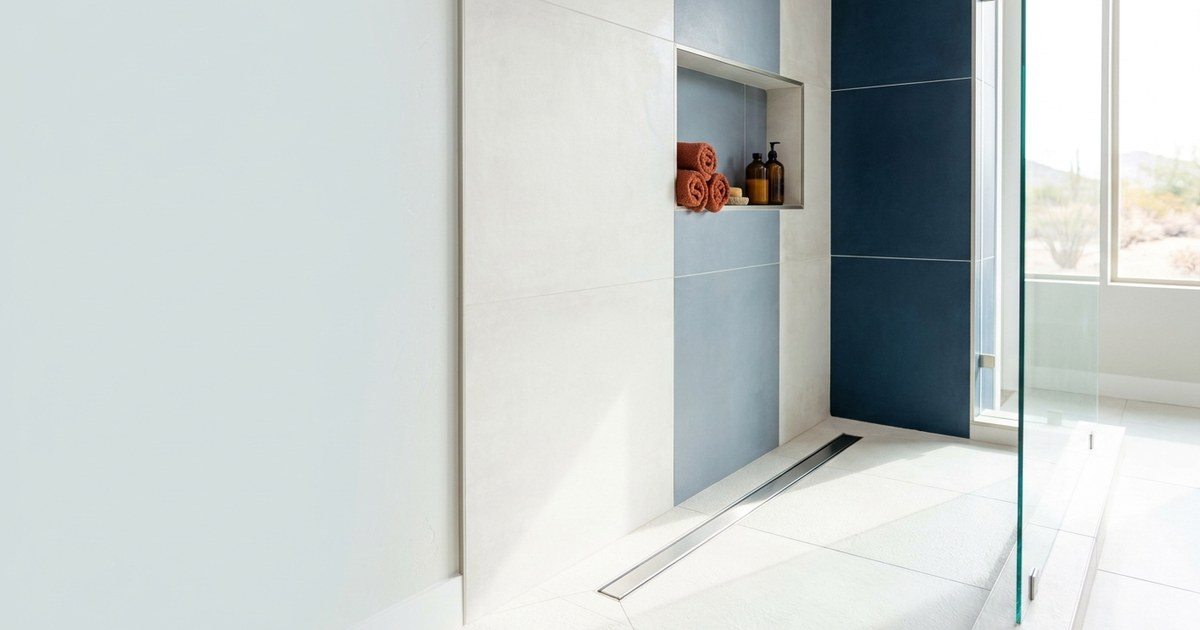
Tile is the part you see, but waterproofing, slope, and layout decide whether a shower lasts. Here is how LJ Builders plans, builds, and warrants custom tile showers in Gilbert, and how to vet any tile contractor before you hire.

Remodeling
Bathroom design services in Arizona go well beyond picking tile. This guide explains what a design package includes, how to plan a spa bathroom for hard water and desert heat, and why one design-build team means fewer hand-offs and one warranty.

Remodeling
Choosing a bathroom contractor in Chandler comes down to a few checks you can verify in writing. This guide covers licensing, references, permits, waterproofing, and the budget factors that move the price. It also shows how to hold any estimate and warranty to a clear standard.