
When choosing a tenant improvement contractor, property managers should verify three non-negotiables: (1) in-house design and permitting capability to eliminate coordination delays, (2) a written workmanship warranty of at least two years (industry standard is one or none), and (3) named commercial references from other property managers or asset owners you can contact directly. These criteria separate full-service contractors (who own the entire process) from general contractors who coordinate subcontractors and pass accountability downstream.
For property managers overseeing commercial office, retail, or medical properties, understanding what tenants need to know about the TI process is only half the equation. The harder part is selecting a tenant improvement contractor in Phoenix who won't become a coordination nightmare when the tenant's move-in date is locked and the clock is running.
The property manager owns every outcome. When a tenant improvement project slips past the lease commencement date, the tenant doesn't blame the electrician or the permit expediter. They blame you. When ownership questions your vendor selection because budget overruns appear, you're accountable. When ADA compliance issues surface at final inspection and delay certificate of occupancy, you're the one explaining the revenue gap.
Contractor selection isn't a procurement checkbox. It's risk mitigation. The difference between a full-service tenant improvement contractor and a subcontractor coordinator determines whether you spend the next 90 days managing a project or triaging daily crises. Property managers who've been burned once develop pattern recognition. They know what fragmented accountability looks like: the general contractor points to the HVAC sub, the HVAC sub points to the electrician, the electrician points to the permit delay, and the PM coordinates a group text while the tenant's furniture delivery sits in a truck outside.
Every contractor promises smooth coordination and on-time delivery. The questions that separate full-service operators from subcontractor coordinators are specific, binary, and uncomfortable. Ask them on the walkthrough. The answers reveal everything.
This is the structural question. A contractor who says "we bring in the best subs for each trade" is telling you they're a coordinator, not a builder. When design, permitting, and construction sit under different roofs, accountability fragments. The architect blames the permit expediter for timeline delays. The permit expediter blames the electrician for incomplete drawings. The electrician blames the HVAC sub for coordination conflicts.
Full-service means one team owns design consultation, permit application and expediting, and every trade from framing to finish work. Our tenant improvement services across Phoenix and the East Valley operate this way: when a problem surfaces, there's no finger-pointing because there's one team to solve it. Ask the contractor to walk you through their in-house capabilities. If they name three different companies they "partner with," you're looking at a coordination model. If they name the people on their payroll who do the work, you're looking at accountability.
Most general contractors offer one year or nothing. LJ Builders offers a two-year written workmanship warranty that covers both new construction and corrections of prior work. That second part matters. If the tenant space you're improving has code violations or shoddy finishes from the previous build-out, a full-service contractor will fix it and warranty the repair.
Ask to see the warranty document before you sign the contract. Read what's excluded. A warranty that doesn't cover "unforeseen conditions" or "pre-existing defects" protects the contractor, not you. A warranty that commits to two years of accountability and includes corrections signals a contractor who stands behind their work in writing, not just verbally during the sales process.
Generic testimonials on a website mean nothing. You need names, properties, and phone numbers. At LJ Builders, our named referral partners include property managers at GreyStar, FSR, and CCMC (companies you can call and ask about timeline adherence, budget accuracy, and problem resolution). A contractor with a track record of repeat business from property managers has proven they understand lease coordination, low-downtime phasing, and the accountability standard commercial work requires.
Ask for three references. Call all three. Ask them: Did the contractor deliver on the promised timeline? Were there surprise costs after contract signing? Who was your single point of contact, and were they empowered to make decisions without delays? How did the contractor handle the inevitable mid-project issue? If the contractor hesitates to provide named references or offers only tenant references (not other PMs), that's a red flag.
This question surfaces where cost overruns and timeline slips hide. A full-service TI contractor with in-house permitting owns this risk. They know Phoenix and East Valley permit timelines, they have relationships with plan reviewers, and they've built contingency into the schedule. A subcontractor coordinator who farms out permitting to an expediter can only report delays, not solve them.
When an inspection fails because of a code interpretation issue, the contractor's permitting expertise determines whether that's a two-day fix or a two-week re-submission. Ask how they've handled inspection failures on past projects. Listen for specifics. "We work closely with the city" is not an answer. "We pre-coordinate MEP rough-ins with the inspector before we close walls" is.
Ask what percentage of their projects encounter unforeseen conditions and how those costs are handled. A contractor who says "we've never had one" is either lying or inexperienced. A contractor who provides a written policy about how contingencies are managed is being honest about construction reality.
Property managers don't have time for "let me check with my boss" conversations. You need someone who can approve a change order, adjust a schedule, or solve a coordination conflict in real time. At LJ Builders, that's Lawrence or Jessica (the owners who personally oversee every project from estimate to punch-list). No project manager layer. No account coordinator filter.
"In our work with property managers and HOA boards, the number-one question we hear after someone's been burned is: 'Who do I call when something goes wrong?' With LJ Builders, it's Lawrence or Jessica. Same two people from estimate to punch-list. No project manager layer, no subcontractor runaround." (Jessica, LJ Builders)
Ask the contractor who you'll be communicating with daily. Ask if that person has signature authority on change orders. Ask if they'll be on-site or managing remotely. A single empowered contact who's accountable for the entire project eliminates the "I'll escalate that and get back to you" delays that cost days.
Residential remodelers pivot to commercial work without understanding lease coordination, ADA compliance standards, or the low-downtime phasing commercial tenants require. A contractor who's built custom homes in Scottsdale is not automatically qualified to deliver a medical office build-out in Tempe where the existing tenant can't close for more than 48 consecutive hours.
Ask for a portfolio of commercial tenant improvements in Phoenix and the East Valley specifically. Look for projects similar in scope and industry to what you're managing. Our commercial build-out and ground-up construction portfolio includes office, retail, and medical spaces (each with distinct permitting, phasing, and compliance requirements). ROC #332589 and 20+ years of local market experience mean we know which inspectors prioritize what, which suppliers deliver on short notice, and which timeline risks are real versus contractor padding.
Ask how many commercial TI projects they've completed in the last 24 months. If the answer is "we're expanding into commercial" or "we've done a few," you're paying for their learning curve.
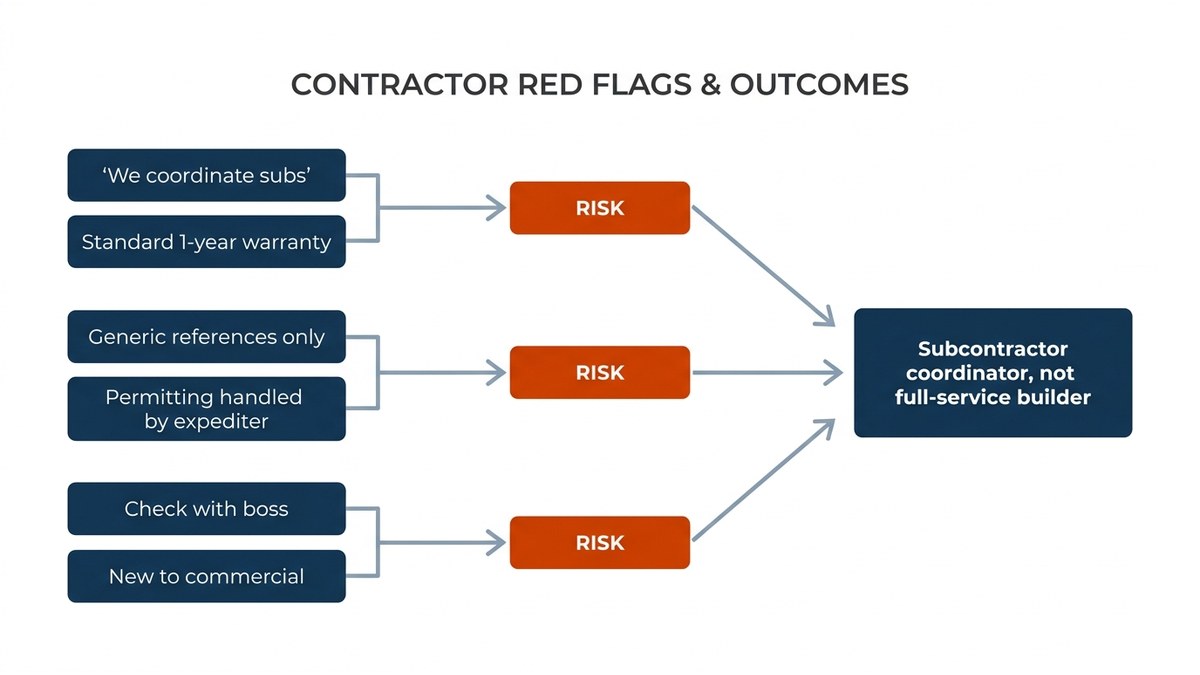
Flip the six questions into warning signs. If you hear any of these responses during the vetting walkthrough, proceed with caution or walk away:
"We work with the best subs in the market." Translation: we coordinate other companies' work. When something goes wrong, you'll be mediating between the GC and the sub who's actually doing the work.
"Standard one-year warranty on workmanship." Industry norm isn't a selling point. It's the floor. A contractor confident in their work offers more. LJ Builders' two-year written warranty covers both new work and corrections of prior defects.
"Here are some testimonials from happy clients." Generic praise without names, properties, or contact information is marketing, not proof. You need to call other property managers and ask hard questions.
"Permitting usually takes 4-6 weeks, but it's out of our hands." A tenant improvement contractor who farms out permitting to an expediter can't control the timeline. A full-service contractor with in-house permit coordination has relationships with plan reviewers and can troubleshoot rejections without waiting for a third party.
"Let me run that by the owner and get back to you." You're talking to someone without decision-making authority. Every change order, schedule adjustment, or problem will require approval from someone you've never met.
"We're expanding into commercial from residential." You're the learning-curve project. They'll figure out commercial permitting, ADA compliance, and tenant coordination on your timeline and your budget.
Vague answers to cost-overrun questions. "We'll work with you" or "unforeseen conditions are rare" without a written contingency policy means you're absorbing risk the contractor isn't willing to carry.
If the contractor exhibits three or more of these flags, you're not talking to a full-service builder.
Full-service isn't a marketing term. It's a structural model. Here's how it plays out:
Design consultation. Lawrence or Jessica walks the space with you and the tenant. We document existing conditions, identify code compliance gaps, and translate the tenant's wishlist into a scope that fits the lease allowance and timeline. No separate architect handoff.
Permitting. We prepare and submit all permit applications in-house. We pre-coordinate plan reviews with city inspectors to catch issues before submission, not after rejection. Whether you're overseeing residential construction and remodeling services or complex commercial builds, streamlined permitting keeps projects on schedule.
Construction. Our crews handle framing, electrical, plumbing, HVAC, drywall, and finish work. Custom cabinetry is built in-house. When an MEP coordination conflict surfaces, the electrician and HVAC tech are both on our payroll. They solve it in real time.
Punch-list and warranty. We conduct a final walkthrough with you and the tenant. Every item on the punch-list is completed before we invoice final payment. The two-year warranty starts at certificate of occupancy. If something fails in year two, we fix it.
"In our work with property managers across the East Valley, the number-one budget surprise isn't unforeseen conditions. It's coordination failure. When the electrician and HVAC sub don't communicate, rework eats significant timeline and budget. Full-service in-house trades eliminate that gap." (Lawrence, LJ Builders)
ROC #332589. Named partnerships with GreyStar, FSR, and CCMC. 20+ years navigating Phoenix and East Valley permitting, inspection, and tenant coordination. That's the track record you're verifying when you call our references.
When a tenant requests TI work, schedule walkthroughs with two to three contractors. Bring the lease, the tenant's wishlist, and the locked move-in date. Ask all six questions on-site while you're standing in the space. Watch how the contractor responds to existing conditions, code compliance gaps, and timeline constraints in real time.
Take notes. A contractor who hedges, defers to "we'll figure that out later," or can't answer permitting timeline questions without calling someone isn't ready for commercial accountability. A contractor who points out specific code issues, suggests phasing options to minimize tenant downtime, and commits to a fixed price and realistic timeline on the walkthrough is showing you full-service capability before you've signed anything.
Compare the answers across all three contractors. Look for consistency between what they promise verbally and what they'll commit to in writing. The contractor who delivers the most detailed written scope, the longest warranty, and named property manager references you can verify is the one who understands what accountability means in commercial work.
Property managers who take this approach avoid most coordination failures, cost overruns, and tenant dissatisfaction that plague TI projects. You're not just hiring a contractor. You're selecting the single point of accountability who will protect your timeline, your budget, and your tenant relationship for the next 90 to 120 days.
When you're ready to vet a tenant improvement contractor who handles design, permitting, and construction under one warranty, LJ Builders delivers that accountability for property managers across Phoenix and the East Valley. Get a Free Estimate and we'll walk the space with you. No subcontractor coordination, no finger-pointing.
— By LJ Builders

Remodeling
LJ Builders handles every phase of custom kitchen design in-house: consultation, permitting, construction, and cabinetry installation. One owner-led team eliminates subcontractor hand-offs and timeline surprises, backed by a 2-year workmanship warranty that doubles the industry standard.

Remodeling
A kitchen renovation contractor in Gilbert should provide in-house design, permitting, construction, and cabinetry under one accountable team. LJ Builders delivers owner-led projects backed by a two-year workmanship warranty, transparent pricing, and 20-plus years of East Valley expertise.

Commercial
When a tenant improvement project goes sideways, the property manager takes the heat. This guide walks through the vetting framework property managers, architects, and HOA boards use to separate capable commercial contractors from coordinators who overpromise and underdeliver.