
Property managers and homeowners in Arizona's East Valley face a critical decision on every commercial tenant improvement, insurance restoration, and residential remodel: hire a full-service general contractor who handles everything in-house, or coordinate fragmented trades through a traditional general contractor who subcontracts each specialty. A full-service general contractor handles design, permitting, construction, and coordination in-house under one accountable team, eliminating subcontractor hand-offs and timeline delays. Fragmented trades require the property owner or a general contractor vs subcontractors model to coordinate multiple specialists, creating accountability gaps when issues arise. The difference: single-point warranty coverage, faster project delivery, and no finger-pointing when something goes wrong.
That's the operational definition. What matters more is the practical outcome: when you hire a full-service contractor, you gain one contact, one warranty, and one team that owns every decision from permit application to final walkthrough. When you hire a traditional general contractor who coordinates subcontractors, you absorb the coordination risk. One delayed trade pushes the entire schedule. One defect becomes a debate over which subcontractor caused it. One change order triggers a cascade of revised bids from three different vendors.
This guide explains what changes when you choose one model over the other, backed by real project data and 20-plus years of integrated construction team experience across Phoenix, Chandler, and Gilbert.
A full-service general contractor performs design, permitting, construction, and warranty support under one business entity. The term "full-service" distinguishes this model from the traditional general contractor vs subcontractors approach, where the GC acts as a coordinator, hiring subcontractors for each trade (electrical, plumbing, framing, drywall, tile) and managing their schedules, contracts, and quality from a distance.
In the full-service model, the contractor employs its own crews or maintains exclusive, long-term relationships with specialists who work under the contractor's direct supervision and warranty. Design decisions, permit applications, construction sequencing, and post-project support all flow through one project manager who reports to the same ownership. When an issue arises, one phone call reaches the integrated construction team accountable for every trade.
LJ Builders operates this way across commercial tenant improvements, insurance restoration, and residential remodels in the East Valley. Lawrence and Jessica personally oversee every project. The company handles architectural coordination, permitting through Chandler, Gilbert, and Mesa building departments, and construction with in-house crews for framing, electrical, plumbing, drywall, painting, and finish carpentry. Custom cabinetry comes from Procraft and HCI, both integrated into LJ Builders' project timelines without third-party delays. The ROC #332589 license covers all trades, and the 2-year workmanship warranty applies to every component because one team performed the work.
Compare this to the traditional model: a general contractor receives bids from three electricians, two plumbers, and a tile subcontractor. The GC selects based on price and availability, signs separate agreements with each, and coordinates their schedules. When the electrician runs conduit that blocks the plumber's path, the GC mediates. When the tile setter finds the shower pan wasn't sloped correctly, the GC calls the framer and the plumber to determine who owns the fix. The property owner or project manager holds one contract with the GC, but the GC holds five contracts with subcontractors, each carrying its own warranty terms, insurance limits, and scheduling constraints.
The operational difference is control. A full-service contractor controls crew schedules, material procurement, quality standards, and warranty enforcement without negotiating with independent businesses. The traditional GC coordinates but doesn't control. That distinction determines who bears the risk when timelines slip or defects surface months after completion. In the full-service model, the contractor absorbs coordination risk. In the fragmented model, the property owner or tenant absorbs it, even if they're paying the GC to manage the process.
LJ Builders' work on casita additions across the East Valley illustrates the advantage. A casita requires foundation, framing, electrical, plumbing, HVAC, drywall, tile, cabinetry, and finish work, all sequenced through inspections at each phase. When one team handles every trade, the project manager schedules inspections based on actual crew availability, not the plumber's next opening two weeks out. When the building department flags a detail in the electrical rough-in, the electrician who performed the work reports to the same project manager who handles the revision, not to a separate subcontractor who may or may not prioritize the fix.
Fragmented trades create three failure modes: timeline delays cascade when one trade misses its window, accountability dissolves when defects involve multiple specialists, and change orders multiply because each subcontractor reprices their scope independently. The property owner or project manager holds the risk in all three scenarios, even when a general contractor is managing the subcontractors.
Integrated project delivery models where design, permitting, and construction are handled by a single accountable team outperform fragmented approaches on timeline and cost predictability. Coordination overhead between independent businesses drives cost overruns and schedule slippage across the construction industry. When hand-offs between independent businesses increase, risk compounds.
LJ Builders sees this in takeover projects. A Gilbert property manager contacted Lawrence after another contractor's subcontractors walked off a commercial bathroom remodel six weeks behind schedule. The original GC had hired separate companies for demolition, plumbing, electrical, tile, and painting. The plumber delayed rough-in by two weeks, pushing the electrician's start date. The electrician arrived but found the plumber's work incomplete, left, and didn't return for another week. The tile setter scheduled his crew based on the original timeline, arrived to find drywall unfinished, and moved to another job. The GC spent three weeks rescheduling, during which the property manager absorbed lost tenant rent. LJ Builders took over, completed the work in three weeks using in-house crews, and issued a 2-year warranty covering both the original scope and the corrections. The difference: one project manager, one crew schedule, one accountability chain.
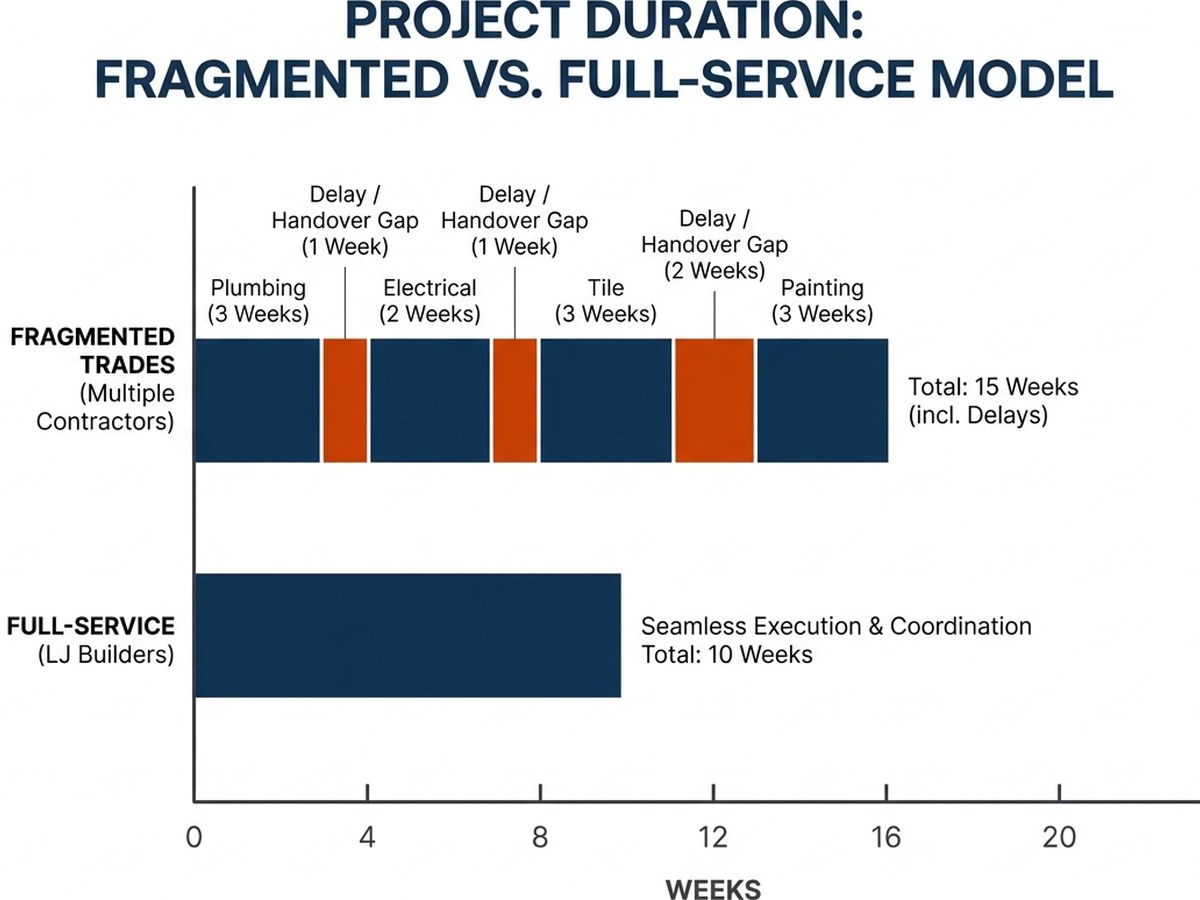
Drywall cannot start until framing and electrical rough-in pass inspection. Cabinets cannot install until drywall is complete and painted. Tile cannot set until the shower pan is sloped, waterproofed, and inspected. Each trade depends on the previous trade finishing on time and to specification. In the fragmented model, the general contractor coordinates these dependencies across independent businesses, each with its own job queue, crew availability, and priority system.
When the plumber delays rough-in by one week, the electrician's scheduled start date becomes invalid. The electrician moves to another job and returns when the plumber finishes, adding another delay. The drywaller arrives to find electrical incomplete, leaves, and doesn't return for two weeks. The property owner loses three weeks of progress because the GC cannot directly control the plumber's schedule or the drywaller's next opening. The coordination risk transfers to the property owner, who pays holding costs (lost rent, extended interest, delayed opening) while the GC attempts to realign schedules.
LJ Builders' kitchen remodeling projects eliminate this failure mode. When framing a load-bearing wall removal, the structural engineer's approval triggers immediate electrical and plumbing rough-in by the same in-house crew that performed the demolition and framing. The project manager schedules the building inspection based on actual crew availability, not a subcontractor's estimate. When the inspector flags a detail, the electrician who performed the work returns the same day because they report to the project manager, not to a separate business with its own schedule. The property owner gains timeline predictability because one team controls every dependency.
The classic scenario: a shower pan leaks six months after completion. Was it the plumber's rough-in, the tile setter's waterproofing membrane, or the framer's slope? In the fragmented model, the general contractor investigates by contacting three subcontractors, each of whom inspects the work and points to another trade. The plumber says the rough-in passed inspection. The tile setter says the membrane was installed per manufacturer spec. The framer says the slope met code. The GC mediates but cannot compel any subcontractor to accept liability if their individual warranty terms exclude consequential damage or limit coverage to their specific scope.
The property owner or homeowner now holds three separate warranty documents, each covering one trade, none of which clearly owns the defect. Resolving the issue requires legal interpretation of warranty language, coordination of three separate repair scopes, and acceptance that one or more subcontractors may refuse to participate. The cost and delay of this process often exceeds the cost of hiring a new contractor to fix the defect outright.
Single-point accountability structures reduce warranty disputes and claim resolution time by eliminating inter-trade finger-pointing. When one contractor performs all trades under one warranty, defect attribution becomes internal rather than adversarial.
LJ Builders' 2-year workmanship warranty covers every trade because one team performed them. When a client reports an issue with tile, plumbing, or cabinetry, Lawrence or Jessica coordinates the diagnosis and repair without consulting external subcontractors. The warranty language is simple: if LJ Builders installed it, LJ Builders fixes it. This isn't just longer than the industry-standard 1-year warranty; it's enforceable without coordination overhead. The property owner makes one phone call and receives one response.
The structural difference between full-service and fragmented trades translates into four client outcomes: faster project delivery, predictable costs with fewer change orders, single-point communication and decision-making, and warranty simplicity when issues arise. These outcomes justify the premium pricing of full-service contractors for property managers and homeowners who value timeline certainty and accountability over lowest upfront cost.
LJ Builders' commercial tenant-improvement work for property management firms like GreyStar, FSR, and CCMC demonstrates these outcomes in practice. Property managers choose full-service contractors because they cannot afford coordination overhead or tenant-facing delays. One contract, one invoice, one warranty, one contact when something needs revision. The commercial build-out projects LJ Builders completes follow this pattern: the property manager provides the tenant's requirements, LJ Builders handles design coordination with the architect, permitting through the city, construction with in-house crews, and final walkthrough with the tenant. The property manager makes decisions at defined milestones but does not manage day-to-day trade coordination.
The table below compares full-service and fragmented-trade models across six dimensions that matter to property managers and homeowners evaluating contractor options.
| Dimension | Full-Service General Contractor | Fragmented Trades (General Contractor vs Subcontractors) |
|---|---|---|
| Timeline Predictability | High: one integrated construction team controls all trade schedules and can adjust in real time without external negotiation | Low: delays cascade when one sub misses their window; GC coordinates but cannot compel availability |
| Change-Order Frequency | Lower: design and construction teams communicate directly; scope changes are priced and executed by the same team | Higher: each sub reprices their scope independently; change orders multiply across trades |
| Warranty Coverage | Single warranty covers all trades for 2 years (LJ Builders standard) | Multiple warranties, each covering one trade for 1 year; gaps and overlaps create disputes |
| Communication Overhead | One contact (project manager) for all decisions, questions, and issues | GC acts as intermediary between property owner and 3-8 subcontractors; decisions take longer |
| Permitting Coordination | Design and permitting handled by the same team that will build; fewer surprises during construction | GC submits permits based on architect's plans; subcontractors may find conflicts during construction |
| Cost Transparency | Fixed price includes all trades; fewer line items and fewer opportunities for surprise costs | Separate bids from each sub; final cost depends on coordination efficiency and change orders |
Projects using single-team accountability complete significantly faster than comparable projects coordinated across independent subcontractors. The time savings come from eliminating scheduling gaps between trades and reducing rework caused by miscommunication.
LJ Builders' bathroom renovation projects illustrate the timeline advantage. A standard conversion involves demolition, plumbing relocation, waterproofing, tile installation, and glass enclosure. When one crew performs demolition, rough plumbing, and waterproofing in sequence without hand-offs, the project completes in 7 to 10 days. When a GC coordinates separate subcontractors for each trade, the same project extends to 14 to 21 days because of scheduling gaps and inspection delays. The property owner or homeowner gains one to two weeks of avoided inconvenience and, in commercial settings, earlier tenant occupancy.
The mechanic behind faster timelines is direct control. A full-service project manager schedules inspections when the crew is ready, not when the subcontractor estimates they'll be ready. When the building inspector flags a detail, the crew returns the same day or the next morning because they report to the project manager, not to a separate business owner who may prioritize another job. Change orders are priced and executed by the same team that designed the original scope, eliminating the delay of soliciting revised bids from multiple subcontractors.
Warranty simplicity is the second tangible outcome of full-service construction. When a property owner or homeowner discovers a defect, they contact one contractor who owns the diagnosis, repair, and cost. No coordination with external subcontractors, no warranty-language disputes, no finger-pointing over which trade caused the issue.
LJ Builders' 2-year workmanship warranty applies to every trade: framing, electrical, plumbing, drywall, tile, cabinetry, and finish work. When a client reports a leak, a cabinet alignment issue, or a paint defect, Lawrence or Jessica coordinates the repair with the same crew that performed the original work. The client makes one phone call and receives one response, typically within 24 hours for urgent issues and within one week for non-urgent items.
This contrasts with the fragmented-trade experience. A homeowner who hired a general contractor to coordinate a master bathroom remodel discovers a tile crack six months later. They call the GC, who contacts the tile subcontractor. The tile sub inspects and claims the crack resulted from substrate movement, not tile installation. The GC contacts the framer, who inspects and claims the framing met code and passed inspection. The homeowner now holds three opinions, no resolution, and a growing repair cost as water damage spreads. Resolving this scenario requires either litigation to enforce warranty terms or hiring a fourth contractor to fix the defect and absorb the cost.
LJ Builders eliminates this failure mode by performing all trades in-house and issuing one warranty document that covers the entire project. The warranty language is clear: if LJ Builders installed it, LJ Builders fixes it. The property owner or homeowner gains peace of mind and predictable post-project support.
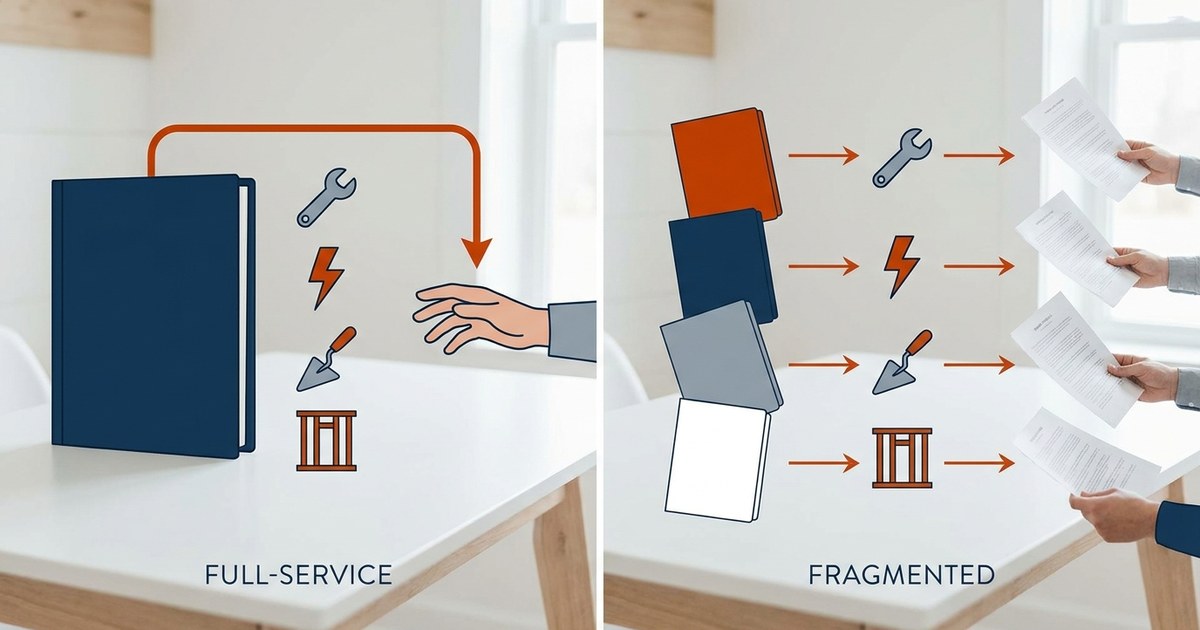
Full-service construction is premium and not appropriate for every project. The model justifies its cost when coordination complexity, timeline certainty, and warranty accountability outweigh the goal of minimizing upfront expense. Property managers, architects, and homeowners should evaluate their project's fit before requesting estimates.
Ideal fits include commercial tenant improvements where tenant move-in dates are fixed and delay costs are high, insurance restoration projects where coordination with adjusters and multiple trades is required, and residential remodels or additions where the homeowner values craftsmanship and long-term warranty support over lowest cost. Full-service contractors excel in scenarios where fragmented trades historically fail: multi-trade projects with tight timelines, takeovers of incomplete or defective work, and projects requiring design coordination with architects or engineers.
Poor fits include budget-driven projects where the property owner or homeowner prioritizes cost over timeline or warranty, very small repairs that don't justify a general contractor's overhead, and projects where the client wants to self-manage trades to control costs. Full-service contractors typically decline projects where the client's primary decision criterion is lowest bid, because the coordination and warranty overhead cannot be eliminated to meet that price point.
LJ Builders positions itself explicitly in this space. "We have a high standard and expect our clients to respect our costs," Lawrence states on the company's About page. This filters out price shoppers and attracts property managers, architects, and homeowners who've experienced the consequences of fragmented trades and are willing to pay a premium to avoid repeating that outcome.
Property managers (GreyStar, FSR, CCMC) choose full-service contractors because tenant move-in dates are contractual obligations, not estimates. A two-week delay in a commercial build-out costs the property owner lost rent and potential lease penalties. A defect discovered after tenant occupancy creates tenant-relations risk and emergency repair costs. Property managers need one accountable point of contact who will deliver on time, fix issues immediately, and stand behind the work for years.
Property management firms increasingly favor integrated delivery models (design-build, full-service general contractors) over traditional general contractor vs subcontractors because the former shifts timeline risk and warranty complexity to the contractor. The property manager holds one contract, makes decisions at defined milestones, and calls one number when something needs attention.
LJ Builders' commercial work follows this pattern. A property manager provides the tenant's requirements and the lease start date. LJ Builders coordinates design with the architect, submits permits, performs construction with in-house crews, and schedules final inspections to align with the lease date. The property manager receives progress updates at framing, rough-in, and final walkthrough, but does not manage daily trade coordination. When the tenant reports an issue six months later, the property manager calls Lawrence or Jessica, not a list of subcontractors.
Homeowners who've lived through a bad remodel (subcontractor chaos, defects, cost overruns) will pay a premium for peace of mind. Full-service contractors justify their cost by eliminating the coordination burden the homeowner otherwise absorbs when hiring a traditional GC or managing trades directly.
LJ Builders' residential addition projects and master bathroom remodels in Chandler serve homeowners who value timeline certainty, design coordination, and long-term warranty support. A casita build involves foundation, framing, electrical, plumbing, HVAC, drywall, tile, cabinetry, and finish work, all requiring coordination through multiple inspections. A homeowner who hires a GC to coordinate subcontractors absorbs the risk of scheduling delays, defect attribution disputes, and warranty gaps. A homeowner who hires LJ Builders pays a premium upfront but gains one project manager, one crew schedule, one warranty, and the confidence that Lawrence and Jessica personally oversee every detail.
The premium is explicit. LJ Builders' estimates include realistic timelines and fixed prices that reflect the cost of owner-led accountability, in-house crews, and a 2-year warranty. Homeowners who request estimates from three contractors will find LJ Builders' price higher than a traditional GC who coordinates cheaper subcontractors. The value proposition is outcome certainty: the project completes on time, defects are owned and fixed, and the homeowner makes one phone call when something needs attention.
Many general contractors describe themselves as full-service but still subcontract most trades. Property managers, architects, and homeowners should ask qualifying questions to verify claims and understand what coordination risk they're accepting.
Do you employ your own crews or subcontract? A full-service general contractor should employ its own carpenters, electricians, plumbers, and painters, or maintain exclusive long-term relationships with specialists who work under the contractor's warranty. If the answer is "we hire the best subcontractors for each project," the model is traditional GC coordination, not full-service.
What trades do you perform in-house vs. coordinate externally? Every contractor subcontracts something (HVAC, specialty glass, structural steel). The question is where the line falls. A full-service contractor typically performs framing, electrical, plumbing, drywall, tile, and finish carpentry in-house. External coordination is limited to specialty trades that require licensed vendors or manufacturers (HVAC, windows, appliances). If electrical, plumbing, and tile are all subcontracted, the model is fragmented.
What does your warranty cover, and for how long? Industry-standard workmanship warranties cover 1 year and exclude subcontractor defects (the GC passes through each sub's individual warranty). A full-service contractor's warranty should cover all trades for at least 1 year, ideally 2 years, because one team performed them. Ask to see the warranty document and read the exclusions. If the warranty excludes "subcontractor work" or limits coverage to "labor only," the contractor is coordinating fragmented trades.
Do you handle permitting and design, or do I hire those separately? A full-service contractor should coordinate design with architects (if required) and handle permit applications, revisions, and inspections. If the contractor requires the property owner to hire a separate design professional and submit permits independently, the model is construction-only, not full-service.
Can you show me a project where you corrected another contractor's work? Takeover projects reveal how a contractor handles defects, incomplete work, and coordination challenges. A full-service contractor should have examples of projects where they took over from a failed GC, diagnosed the issues, completed the work, and issued a warranty covering both the original scope and the corrections. If the contractor has no takeover experience, they may not have the breadth of in-house capability to handle complex multi-trade issues.
These questions help property managers, architects, and homeowners distinguish full-service contractors from traditional GCs who use the term as marketing language. The answers determine whether the contractor shifts coordination risk to themselves or transfers it to the client.
LJ Builders operates as a true full-service general contractor across commercial tenant improvements, insurance restoration, and residential remodels in Chandler, Gilbert, Mesa, and Phoenix. Lawrence and Jessica personally oversee every project from initial consultation through final walkthrough. The company handles design coordination with architects, permitting through city building departments, construction with in-house crews, and warranty support for two years after completion.
ROC #332589 covers all trades LJ Builders performs: framing, electrical, plumbing, drywall, tile, painting, and finish carpentry. Custom cabinetry comes from Procraft and HCI, both integrated into LJ Builders' project schedules without third-party delays. This breadth of in-house capability eliminates the coordination gaps that plague fragmented-trade projects.
LJ Builders' 20-plus years of East Valley relationships (building inspectors, suppliers, referral partners) translate into faster permit approvals, better material availability, and predictable project timelines. When a building inspector flags a detail in a rough-in, Lawrence or Jessica knows the inspector's standards and coordinates the revision the same day. When a supplier's lead time extends, LJ Builders' purchasing relationships often secure priority delivery. These operational advantages compound over the course of a multi-trade project, reducing delay risk for the property owner or homeowner.
The company's referral network includes property management firms (GreyStar, FSR, CCMC), architects, and insurance adjusters who repeatedly choose LJ Builders for coordination-intensive projects. This repeat business proves that the full-service model works in practice, not just theory. Property managers return because tenant move-ins happen on time. Homeowners return (and refer neighbors) because defects are fixed immediately and warranty claims are honored without dispute.
LJ Builders' work on home addition projects demonstrates the full-service advantage. A room addition or second story involves foundation or structural engineering, framing, electrical, plumbing, HVAC, drywall, flooring, and finish work. When one team handles every trade, the homeowner gains timeline predictability, cost transparency, and warranty simplicity. When a traditional GC coordinates subcontractors, the homeowner absorbs scheduling delays, change-order cascades, and post-project finger-pointing when defects arise.
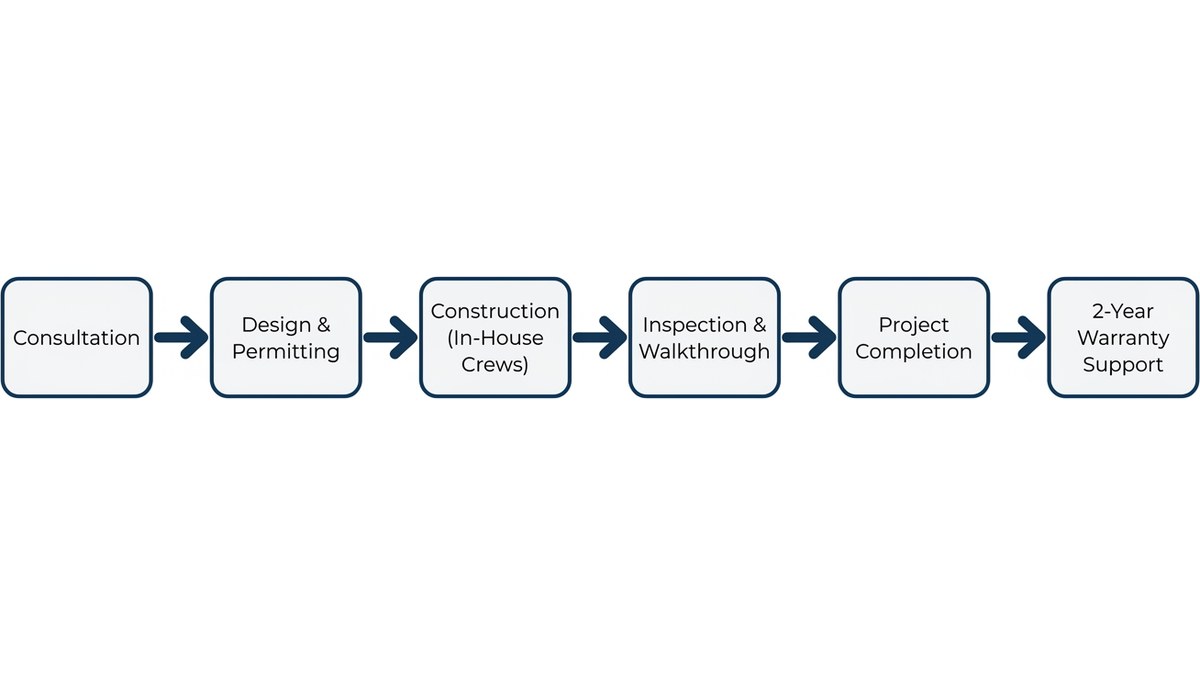
Fragmented trades create coordination risk and accountability gaps that cost property managers and homeowners time, money, and stress. Full-service contractors eliminate both by handling design, permitting, construction, and warranty under one accountable team. The premium cost of full-service reflects the value of timeline certainty, warranty simplicity, and single-point communication.
The right choice depends on project complexity and the client's tolerance for coordination overhead. Budget-driven projects and very small repairs don't justify full-service overhead. Commercial tenant improvements with fixed move-in dates, insurance restoration projects with multiple trades, and residential remodels where craftsmanship and warranty matter more than lowest upfront cost all favor full-service contractors.
If you're planning a commercial build-out, residential remodel, or casita addition in the East Valley and want to avoid the coordination chaos of fragmented trades, LJ Builders handles design, permitting, construction, and warranty under one accountable team led by Lawrence and Jessica.

Remodeling
LJ Builders handles every phase of custom kitchen design in-house: consultation, permitting, construction, and cabinetry installation. One owner-led team eliminates subcontractor hand-offs and timeline surprises, backed by a 2-year workmanship warranty that doubles the industry standard.

Remodeling
A kitchen renovation contractor in Gilbert should provide in-house design, permitting, construction, and cabinetry under one accountable team. LJ Builders delivers owner-led projects backed by a two-year workmanship warranty, transparent pricing, and 20-plus years of East Valley expertise.

Commercial
When a tenant improvement project goes sideways, the property manager takes the heat. This guide walks through the vetting framework property managers, architects, and HOA boards use to separate capable commercial contractors from coordinators who overpromise and underdeliver.