
When your tenant signs a lease that includes a build-out deadline, you need one accountable contractor who can deliver the entire scope on time. You don't want a daisy chain of subcontractors pointing fingers when the timeline slips.
A lease improvement contractor in Arizona handles the design, permitting, and construction of tenant improvements. These are the build-outs and renovations tenants make to leased commercial space. In Arizona, a licensed contractor (ROC #332589 or equivalent) pulls permits, coordinates trades, and delivers the project on time under one accountable contract. Full-service contractors eliminate the coordination risk and warranty gaps that come with piecing out separate subcontractors.
Property managers across the East Valley face this challenge repeatedly. A retail tenant needs HVAC zones, partition walls, electrical upgrades, and custom finishes before their grand opening. The electrician blames the framing crew for being late. The HVAC sub schedules around another job. Permitting mistakes surface after drywall goes up. The lease deadline becomes a moving target. This piece explains what full-service delivery looks like, why it eliminates that risk, and how to vet lease improvement contractors in Arizona in the state's regulatory environment.
A lease improvement contractor in Arizona (sometimes called a TI contractor) delivers the physical changes a tenant needs to make a leased space functional for their business. The landlord provides the shell (base building). The tenant funds everything inside that shell: partition walls, HVAC zones, electrical panels, plumbing rough-ins, finishes, fixtures. The contractor's scope starts where the landlord's responsibility ends.
Base building is what the landlord delivers. It includes the structural shell, roof, exterior walls, common-area utilities, and a demising wall to separate one tenant space from another. Lease improvements are tenant-funded additions. A retail tenant might add a restroom, a back-office partition, a grease trap for a food operation, and custom storefront glazing. An office tenant might install cubicles, a conference room, upgraded HVAC controls, and data cabling. The contractor pulls permits, coordinates trades, and delivers the project to match the tenant's signed scope.
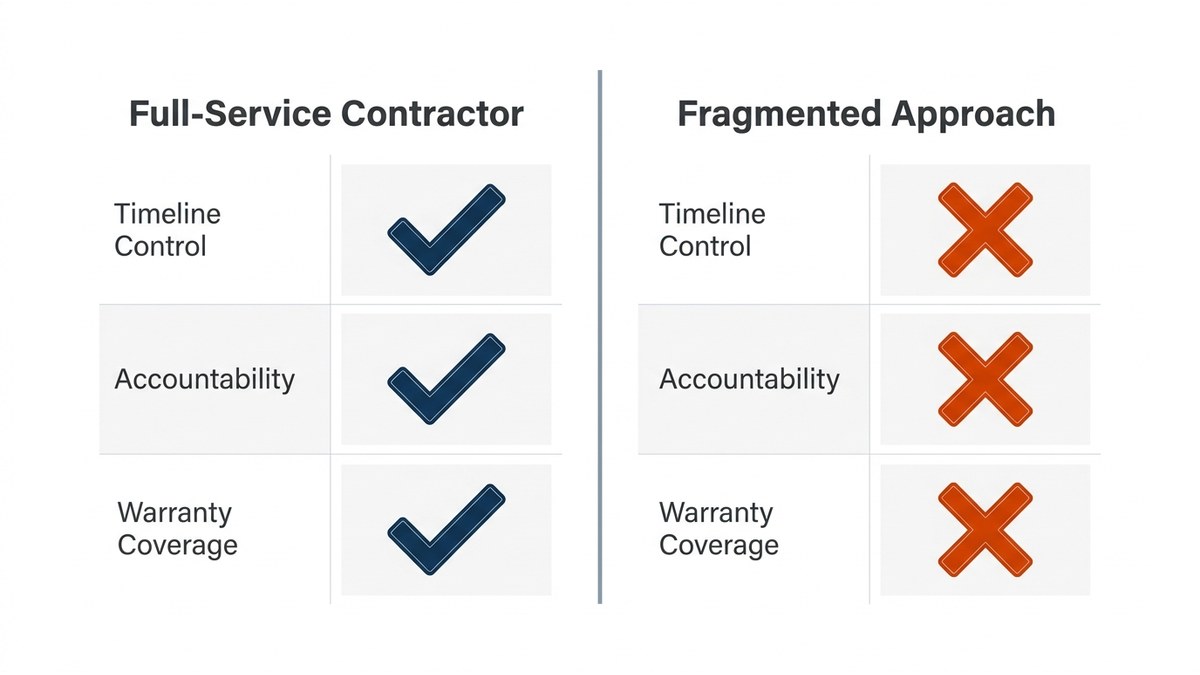
Full-service means one contract covers design consultation, permit pulls, multi-trade construction (framing, HVAC, electrical, plumbing, drywall, paint, flooring), inspections, punch-list corrections, and warranty. The contractor is the single point of accountability. When the electrician and the HVAC sub need to coordinate rough-in schedules, the contractor handles it. When a permit detail needs clarification, the contractor calls the jurisdiction. When something goes wrong post-occupancy, the contractor returns under warranty. No runaround. No finger-pointing.
When trades are separately contracted, delays cascade. The electrician can't rough-in until framing passes inspection. The HVAC sub schedules around another job because they don't know when the space will be ready. A permitting mistake surfaces late because no one owns the whole scope. Each handoff is a risk point.
In our work with property managers across the East Valley, we have taken over multiple lease improvement projects in the past 18 months. In these cases, the original contractor walked off-site mid-build because subcontractors could not agree on who caused a permit rejection. We finished them under one contract with a 2-year warranty. One contract, one timeline, one warranty. If something goes wrong, there is no question who fixes it. That certainty matters when a tenant's lease includes a hard opening date tied to revenue.
Commercial general contractors in Phoenix, AZ who deliver integrated service eliminate the coordination failure mode. You get a fixed scope, a realistic timeline with inspection milestones, and a single phone number when questions arise. The largest construction firms increasingly adopt integrated delivery models specifically to reduce schedule variance and warranty disputes.
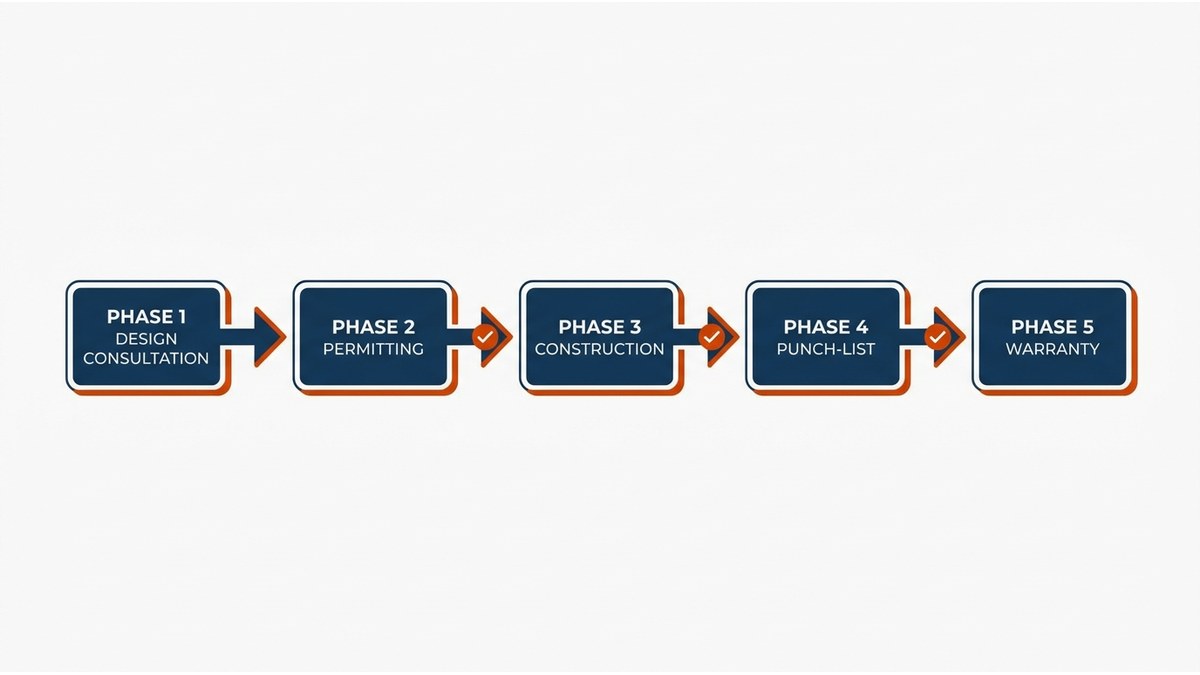
A full-service lease improvement moves through five phases. Each phase has a clear deliverable and a handoff point the property manager and tenant can verify.
In-house design review confirms the tenant's space plan meets code. This includes ADA, fire-separation, and egress requirements. The contractor selects materials, verifies compatibility with the landlord's base-building systems, and produces a fixed scope document. Both landlord and tenant sign off before construction starts. Outcome: a scope the contractor can price accurately and deliver on schedule. This coordination is critical for HOA and property management construction services in Phoenix, AZ where multiple stakeholders review changes.
Arizona cities (Chandler, Gilbert, Mesa, Phoenix, Scottsdale, Queen Creek) each have permitting nuances. Chandler and Gilbert process commercial permits faster but enforce stricter fire-separation requirements for multi-tenant retail. Mesa and Phoenix require additional grease-trap and hood permits for restaurant build-outs. Scottsdale has design-review overlays on certain corridors. The contractor pulls permits, schedules inspections, and coordinates with the jurisdiction. Outcome: an approved permit set and a locked inspection schedule.
Framing, electrical, HVAC, plumbing, drywall, paint, and flooring happen in sequence. The contractor schedules all trades, handles material procurement, and maintains a single timeline. If the HVAC sub needs access before drywall, the contractor adjusts the electrical rough-in to clear the path. If a material delivery is delayed, the contractor reschedules trades to avoid downtime. Outcome: completed build-out, passed final inspection, ready for occupancy. Questions about scope or next steps? Contact LJ Builders for a free construction estimate to discuss detailed project coordination.
Final walkthrough identifies corrections. This includes paint touch-ups, hardware adjustments, and fixture alignments. The contractor completes the punch-list, passes final inspection, and obtains the occupancy permit. Outcome: keys handed to the tenant, space ready for business on the agreed date.
A 2-year workmanship warranty covers defects in construction. Industry standard is 1 year or none. If a drywall seam cracks, if a door hinge loosens, if an electrical outlet fails, the contractor returns. No debate over which sub is responsible. The warranty is backed by the same entity that signed the original contract.
Arizona-specific regulatory context determines which contractors can legally deliver lease improvements and how long the permitting phase takes.
Arizona ROC (Registrar of Contractors) licensing requires commercial contractors to hold a valid ROC license to pull permits. LJ Builders holds ROC #332589. Unlicensed operators cannot pull permits legally and leave liability on the property manager when the jurisdiction red-tags the project. Verify any contractor's license status at the Arizona ROC website before you sign a contract.
City-by-city variance affects timelines and scope. Chandler and Gilbert have faster permit turnaround. They process straightforward tenant improvements in 7 to 10 business days. However, they enforce stricter fire-separation requirements for multi-tenant retail buildings. Mesa and Phoenix require additional permits for restaurant build-outs: grease-trap connections, Type I hood systems, and fire-suppression integration. Scottsdale's design-review overlay districts add 2 to 4 weeks for aesthetic approval on certain corridors. A lease improvement contractor in Arizona who works across the East Valley knows these nuances and builds them into the project timeline. Residential construction and remodeling services in Phoenix, AZ follow different permitting paths, so verify your contractor has commercial construction experience in Arizona.
Inspection cadence determines the critical path. A typical lease improvement requires five inspections: rough-in framing, MEP (mechanical, electrical, plumbing) rough-in, insulation and vapor barrier, drywall and finishes, and final. Miss one inspection window and the whole schedule slips a week. Full-service contractors own the inspection calendar and coordinate trade sequencing to avoid delays.
Property managers and architects need a checklist to separate accountable contractors from operators who overpromise and underdeliver.
Verify ROC license status. Use the Arizona ROC lookup tool to confirm the contractor holds an active license with no suspensions and the correct classification (commercial or general building). ROC #332589 is LJ Builders' license. If a contractor cannot provide their ROC number immediately, walk away.
Ask for a detailed scope and fixed-price proposal. Vague estimates like "fifty dollars per square foot, depends on finishes" are a red flag. You need line-item costs: labor, materials, permits, inspection fees, and contingency. A fixed-price proposal protects you from scope creep and surprise charges mid-project.
Request a project timeline with inspection milestones. If the contractor cannot produce a Gantt chart or critical-path schedule showing when each trade starts, when inspections occur, and when the tenant receives keys, they are winging it. Lease deadlines are non-negotiable. The timeline must account for permitting turnaround in your specific city.
Check the warranty. One year is industry standard. Two years signals confidence in workmanship. LJ Builders provides a 2-year workmanship warranty on all lease improvements. If something fails post-occupancy, we return and fix it under the original contract.
Ask for references from property managers or architects. Specifically, other lease improvement projects in Arizona, not just residential remodels. Call those references and ask: Did the contractor hit the timeline? Were there surprise costs? How did they handle mid-project changes? Did they return for warranty work promptly?
Confirm insurance and bonding. General liability coverage requirements vary by project size and landlord requirements. However, commercial construction in Arizona typically requires minimum $1 million coverage. Workers' compensation is mandatory under Arizona law. The landlord's lease will require proof of insurance before construction starts. Do not assume the contractor carries it. Ask for certificates upfront. Verify coverage details with your insurance advisor or the Arizona Department of Insurance and Financial Institutions.
Lease improvements are high-stakes. Late delivery costs the tenant revenue. Scope creep costs the property manager budget overruns and landlord disputes. Warranty gaps cost reputation when defects surface post-occupancy. Full-service contractors eliminate those risks by owning design, permitting, construction, and warranty under one accountable contract.
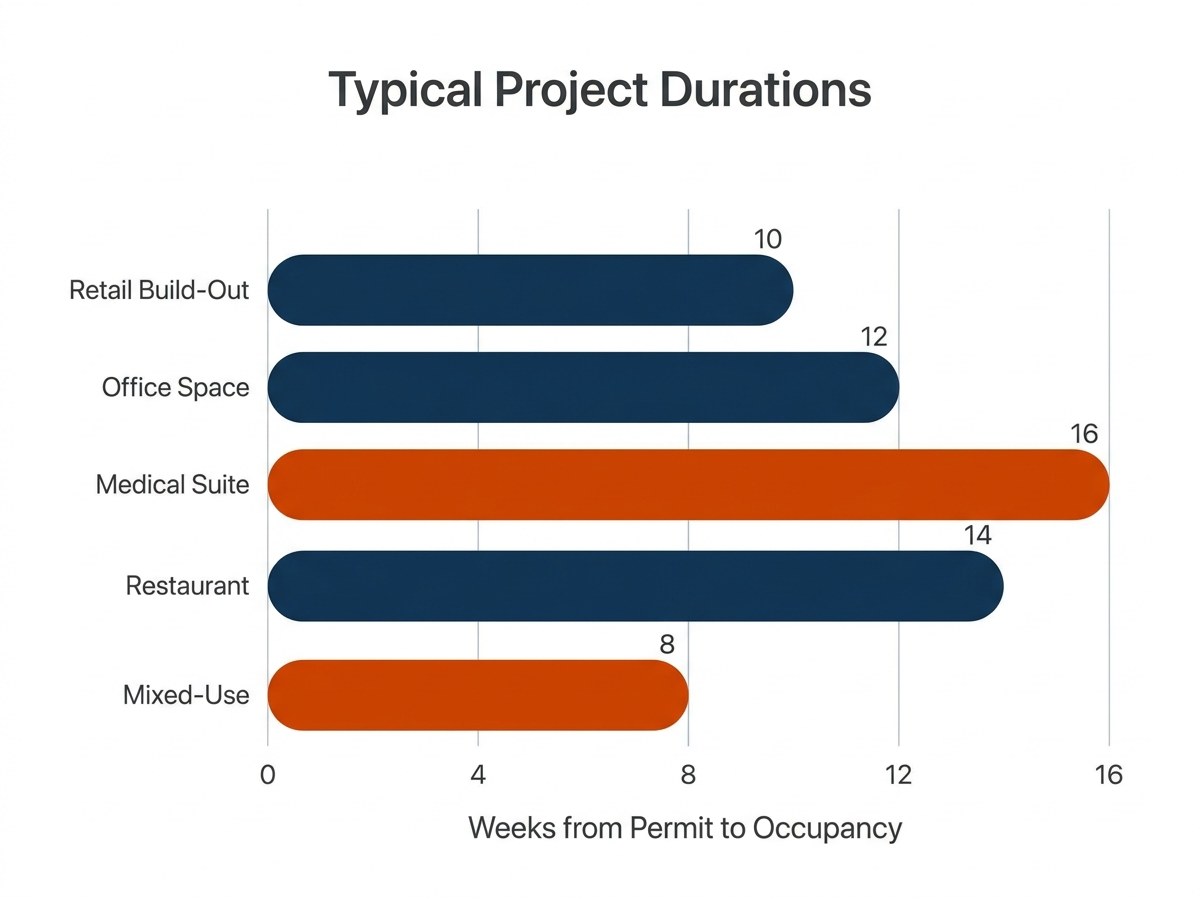
LJ Builders has delivered tenant improvements, office build-outs, and retail renovations across the East Valley. We work with property managers (GreyStar, FSR, CCMC), architects, and small business owners. We are licensed (ROC #332589), insured, and backed by a 2-year workmanship warranty. Lawrence and Jessica personally oversee every project. Our average timeline for a 2,500-square-foot retail build-out in Gilbert is 8 to 10 weeks from permit submission to final inspection. Landlords and tenants both need that certainty upfront.
If you are managing a lease improvement project in Chandler, Gilbert, Mesa, Phoenix, Scottsdale, or Queen Creek, you need a contractor who treats the timeline and budget as non-negotiable. One contract. One contact. One warranty.

Remodeling
LJ Builders handles every phase of custom kitchen design in-house: consultation, permitting, construction, and cabinetry installation. One owner-led team eliminates subcontractor hand-offs and timeline surprises, backed by a 2-year workmanship warranty that doubles the industry standard.

Remodeling
A kitchen renovation contractor in Gilbert should provide in-house design, permitting, construction, and cabinetry under one accountable team. LJ Builders delivers owner-led projects backed by a two-year workmanship warranty, transparent pricing, and 20-plus years of East Valley expertise.
Commercial
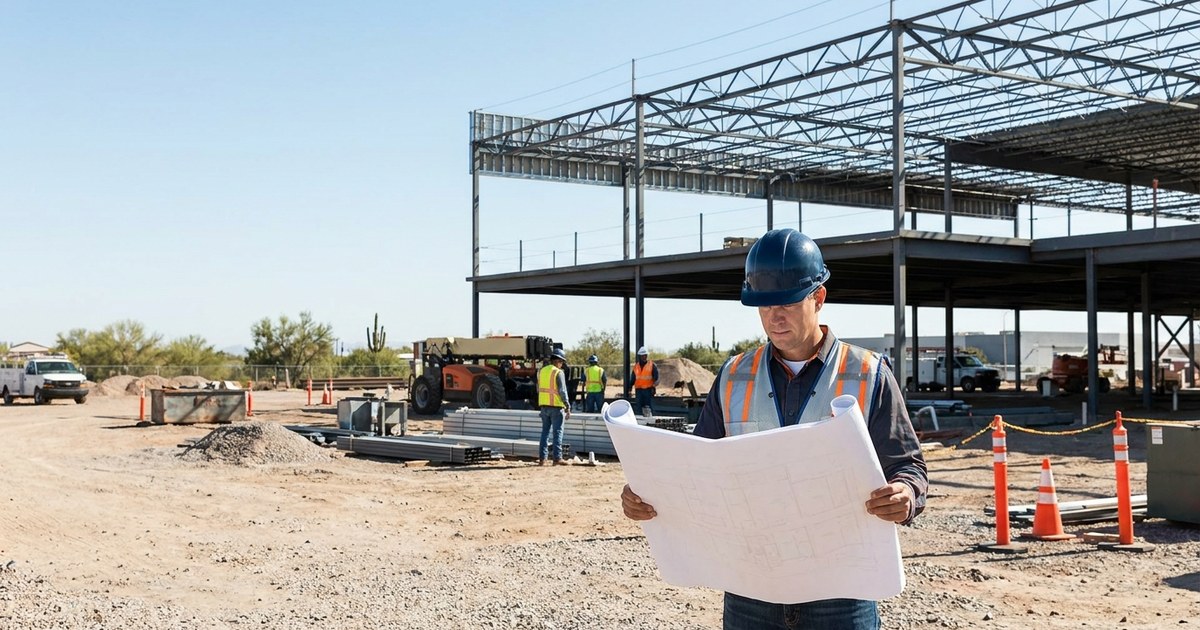
When a tenant improvement project goes sideways, the property manager takes the heat. This guide walks through the vetting framework property managers, architects, and HOA boards use to separate capable commercial contractors from coordinators who overpromise and underdeliver.