Commercial expansion in Arizona makes sense when lease costs, operational constraints, or revenue growth justify the upfront investment in square footage. The decision hinges on three factors: whether your current lease permits modifications, whether local zoning allows the addition or build-out, and whether the cost per square foot beats relocation. Property managers and business owners typically expand when tenant demand exceeds capacity, when lease renewal terms make staying attractive, or when brand continuity and location equity outweigh moving costs.
For property managers, HOA board members, and commercial property owners across the Phoenix East Valley, the choice between expanding an existing building and relocating to new space is rarely straightforward. Permit timelines, zoning restrictions, tenant disruption, and the real cost per added square foot all factor into the decision. This article breaks down when expansion makes financial sense, what Arizona-specific permitting and zoning realities you'll face, and how to manage construction without shutting down revenue-generating operations. If you're evaluating commercial expansion in Arizona options, request a free commercial construction estimate to see how the numbers work for your property.
The financial case for business expansion starts with a break-even analysis: cost of expansion (permitting, construction, downtime) against cost of relocation (moving expenses, lease buyout, tenant disruption, and brand impact). Expansion wins when lease renewal terms are favorable, when your location carries foot traffic and brand recognition, and when moving would risk tenant retention. Relocation wins when your lease prohibits modifications, when local zoning won't allow the expansion you need, or when the cost per square foot of new space is lower than renovation plus addition.
According to research from CBRE's Americas Office Viewpoint report, the threshold for expansion versus relocation typically falls between 60 and 70 percent. In our work with East Valley property managers over the past 20 years, we've found that expansions pencil out when the cost per added square foot runs within this range compared to relocating and building out new space. That threshold accounts for permitting fees, construction labor, temporary operational adjustments, and the warranty period that protects against callbacks.
Office lease renewals accounted for 60 percent of total leasing activity in major U.S. markets in 2023, reflecting tenant preference for continuity when expansion planning makes financial sense. The East Valley (Gilbert, Chandler, Mesa, and Queen Creek) has seen sustained demand for office, retail, medical, and multi-family space. When your existing location has tenant demand exceeding capacity, when renewal terms make staying attractive, or when relocating would disrupt established customer patterns, expansion becomes the logical path.
Key takeaway: expansion makes financial sense when the cost per square foot of added space compares favorably to relocation costs, your lease permits modifications, and your location carries brand equity worth protecting.
For a detailed breakdown of what property managers need to budget and plan for when expanding an existing building, read our guide on building an addition to your commercial property, including permits, timeline, and costs.
Not all commercial parcels allow vertical or horizontal expansion. Mixed-use zoning in Arizona jurisdictions may carry setback requirements, height restrictions, or use limitations that constrain what you can build. Before you design, confirm zoning compliance with the local planning department. A parcel zoned for retail may allow an addition, but a parcel zoned for light industrial may prohibit certain height increases or require additional parking.
Phoenix and East Valley jurisdictions typically take four to eight weeks for commercial addition permits, depending on complexity and whether plans require fire marshal or structural engineer review. According to Fort Worth's development process documentation, similar historic mixed-use portfolio projects required commercial addition permits with fire marshal and structural engineer review. Arizona's East Valley jurisdictions follow comparable processes, though Arizona's four to eight week timeline is typically faster than other major metros.
Arizona requires ROC-licensed contractors for commercial property growth work. LJ Builders holds ROC #332589, proof of compliance with state licensing, bonding, and insurance requirements. Full-service contractors who handle design and permitting in-house eliminate the most common delays: incomplete plans, missing engineer stamps, fire sprinkler revisions, and ADA compliance updates. When one team coordinates the entire sequence from design through final inspection, you avoid the finger-pointing and scheduling gaps that push timelines out by weeks.
Common permitting delays include incomplete structural calculations, missing mechanical or plumbing load data, and fire sprinkler system revisions that require re-submission. A contractor who employs a dedicated permitting coordinator and maintains working relationships with local building departments can navigate these bottlenecks without adding months to your schedule.
Key takeaway: commercial expansion in Arizona permits take four to eight weeks in the East Valley when plans are complete and the contractor coordinates directly with local jurisdictions.
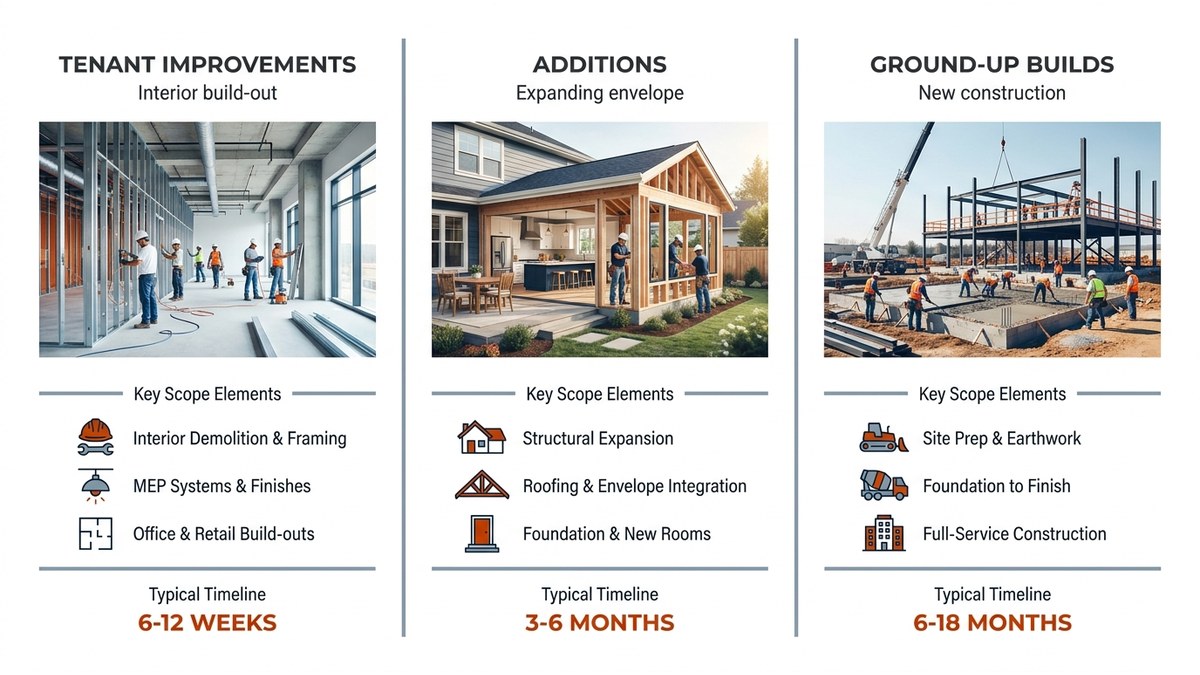
Commercial expansion falls into three categories: tenant improvements (modifying interior space within the existing envelope), additions (expanding the building footprint or adding vertical space), and ground-up builds (new construction on vacant or cleared land). Each pathway serves different needs and carries different timelines and regulatory requirements.
Tenant improvements modify interior space within an existing building envelope. Scope includes walls, HVAC, plumbing, electrical, and finishes to accommodate a new tenant or expanded use. Tenant improvements make sense when your lease allows modifications, when the building has excess square footage to reconfigure, and when you don't need to expand the exterior footprint.
Timeline for typical office or retail build-outs ranges from six to twelve weeks, depending on scope and permitting complexity. Medical and dental tenant improvements require additional inspections and may extend the timeline to twelve to sixteen weeks. LJ Builders delivers office, retail, and medical tenant improvements across Phoenix and the East Valley with minimal downtime, coordinating work schedules to keep existing operations running.
Key considerations: confirm lease terms permit the modifications you need, verify that existing MEP (mechanical, electrical, plumbing) systems can support the new load, and budget for permits even when work stays within the building envelope.
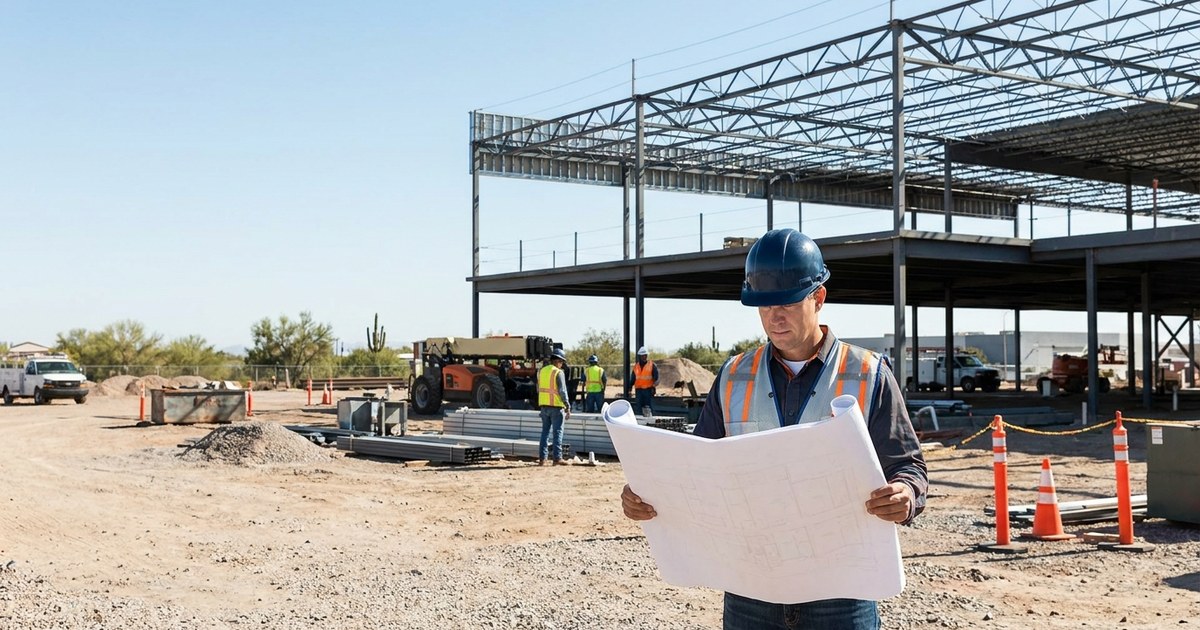
Additions add square footage by extending the building horizontally (an annex or wing) or vertically (a second story or mezzanine). This pathway requires structural engineering, foundation work, and full permitting. Additions make sense when zoning allows expansion, when the cost per square foot of added space is lower than relocation, and when operational continuity is critical.
Timeline for typical commercial additions ranges from three to six months, depending on complexity, permitting, and site conditions. Coordination with structural engineers, surveyors, and local fire marshals determines schedule success. The most common delays stem from foundation design revisions (soil reports that reveal unexpected conditions), fire sprinkler system upgrades required by code when you increase building square footage, and ADA compliance triggered by the addition.
Key considerations: confirm zoning allows the addition you need, budget for structural engineering and foundation work, and plan for fire sprinkler and ADA upgrades triggered by increased square footage.
Ground-up builds are new construction on vacant or cleared land. Scope includes full design, permitting, foundation, MEP, and finish work. Ground-up builds make sense when no existing structure can accommodate your needs, when land is cheaper than retrofitting, or when your brand requires custom design.
Timeline for ground-up commercial projects ranges from six to eighteen months, depending on size and complexity. Zoning, site preparation, and utility connections for natural gas infrastructure add lead time before construction begins. LJ Builders delivers commercial tenant improvements, build-outs, and ground-up construction across Phoenix and the East Valley, managing every phase from design through final inspection.
Key considerations: confirm zoning and land use before purchase, budget for site preparation (grading, utilities, parking), and factor in six to twelve months for design and permitting before construction starts.
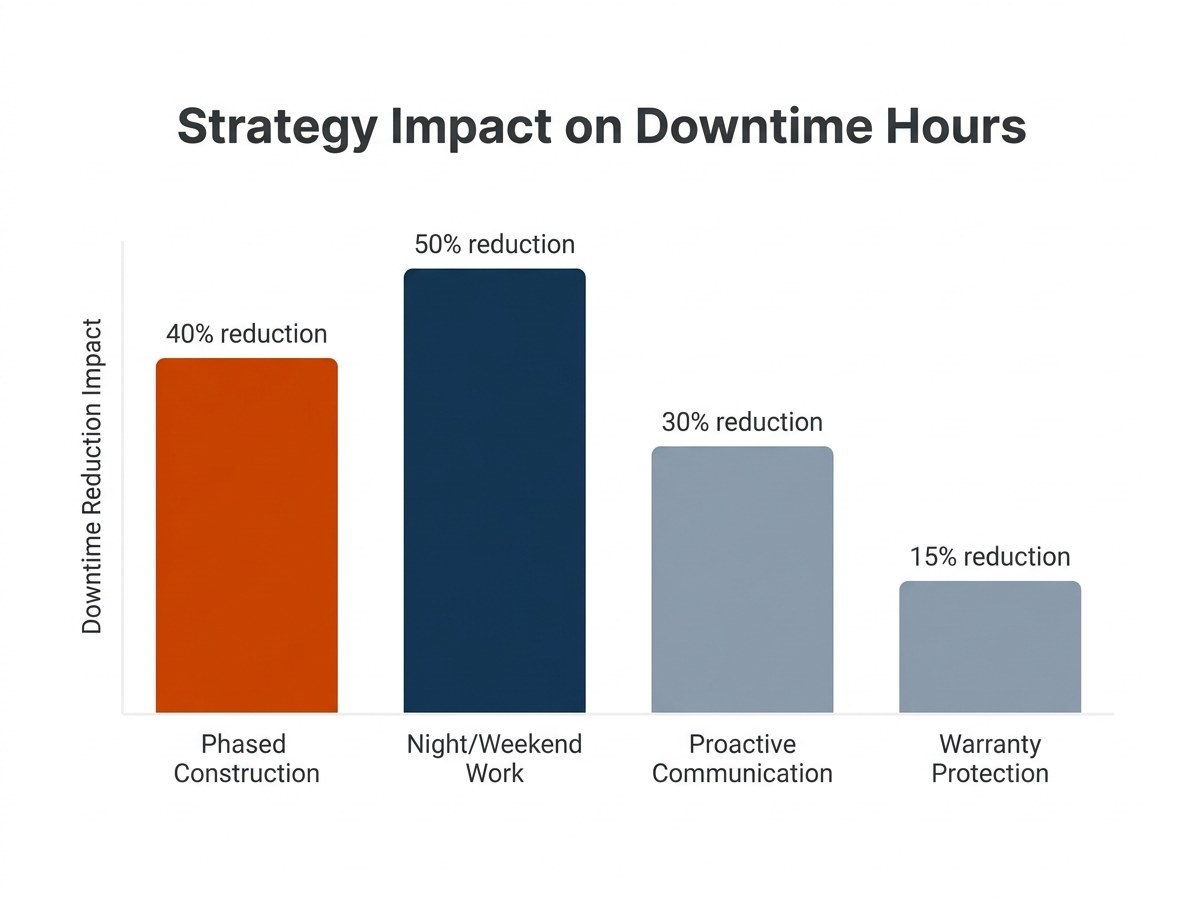
Construction that shuts down revenue-generating operations is the property manager's biggest risk. Phased construction keeps existing operations running while adding space. This approach uses night and weekend work, temporary barriers, and staged permitting to minimize tenant impact.
Tenant communication plans matter. Proactive timelines, noise and dust mitigation, and parking and access coordination prevent complaints and lease disputes. A single point of accountability eliminates subcontractor hand-offs that cause delays and confusion. When one team manages design, permitting, construction, and punch-list, the property manager has one contact for every question and every decision.
The two-year workmanship warranty LJ Builders provides (versus the one-year industry norm) functions as downtime insurance. Callbacks and rework disrupt operations post-completion. A longer warranty period signals confidence in craftsmanship and reduces the risk that you'll need to bring crews back on-site after tenants move in. This same owner-led, low-disruption approach applies whether you're managing multi-family amenity upgrades or handling residential construction and remodeling services in Phoenix, AZ where occupant schedules and living conditions demand careful coordination.
According to NIST's framework for designing green buildings, focus on low-water-usage systems and minimum-impact materials reduces long-term operational costs and tenant disruption during construction. Selecting materials and systems that require less maintenance and generate less waste during installation minimizes the operational footprint of commercial expansion in Arizona.
LJ Builders delivers organized, low-disruption construction for HOAs and property managers across Phoenix and the East Valley, coordinating schedules to keep tenants informed and operations running.
Key takeaway: phased construction, proactive tenant communication, and a single point of accountability minimize operational downtime during commercial expansion.
One team, start to finish. Design consultation, permitting, construction, custom cabinetry through Procraft and HCI, and punch-list warranty support happen in-house. No subcontractor runaround, no delays, no finger-pointing. Lawrence and Jessica personally oversee every project. Named referral partners including GreyStar, FSR, and CCMC trust LJ Builders with their commercial portfolios because accountability sits with the owners.
ROC #332589 and twenty-plus years of experience back every estimate and timeline. The two-year workmanship warranty differentiates LJ Builders from contractors who deliver a one-year warranty and walk away. When you expand with LJ Builders, you know who to call if something needs adjustment after completion.
If you're evaluating commercial expansion for your East Valley property, request a free estimate from LJ Builders. Lawrence or Jessica will personally review your project scope, timeline, and budget within 24 hours. You'll receive a detailed scope, fixed price, and realistic timeline so you know exactly what you're getting and when.
According to the U.S. Energy Information Administration's Commercial Buildings Energy Consumption Survey, energy efficiency improvements during expansion can reduce long-term operational costs by 20 to 30 percent, making the upfront investment in quality systems and materials a smart financial decision for property managers planning multi-year hold periods.
Remodeling
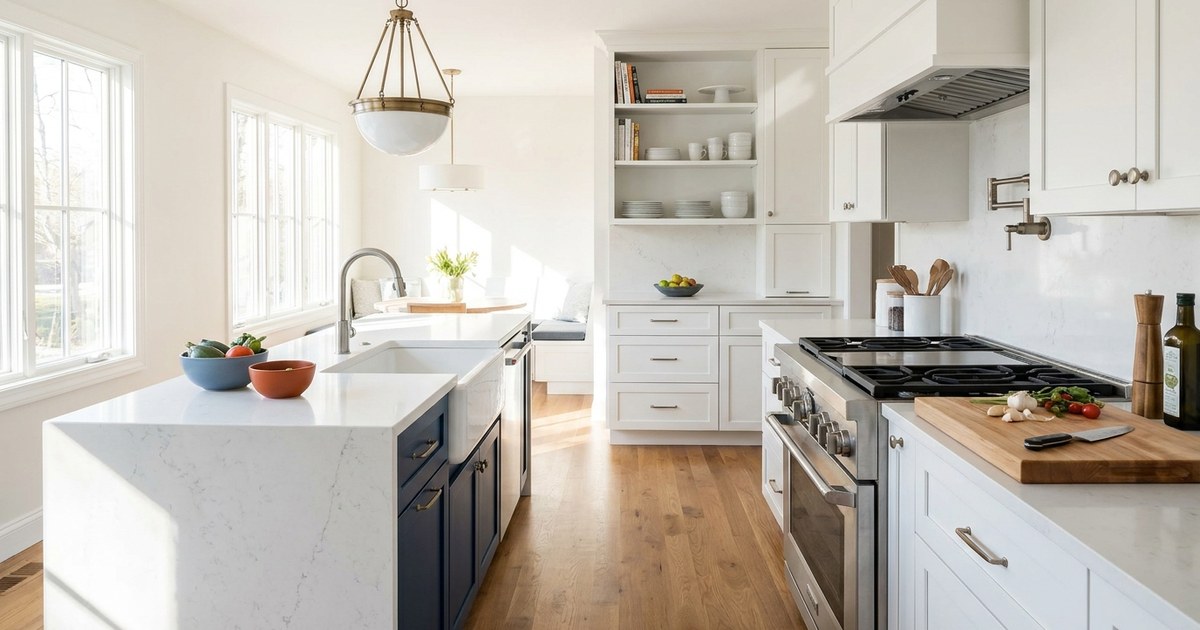
LJ Builders handles every phase of custom kitchen design in-house: consultation, permitting, construction, and cabinetry installation. One owner-led team eliminates subcontractor hand-offs and timeline surprises, backed by a 2-year workmanship warranty that doubles the industry standard.

Remodeling
A kitchen renovation contractor in Gilbert should provide in-house design, permitting, construction, and cabinetry under one accountable team. LJ Builders delivers owner-led projects backed by a two-year workmanship warranty, transparent pricing, and 20-plus years of East Valley expertise.
Commercial
When a tenant improvement project goes sideways, the property manager takes the heat. This guide walks through the vetting framework property managers, architects, and HOA boards use to separate capable commercial contractors from coordinators who overpromise and underdeliver.